Marketing
What Is A Marketing Funnel: Top Of Funnel Marketing
Answering all your most common questions about top of funnel marketing, from our recommended DTC brand examples to key tactics and best practices.
Key Takeaways: What Is A Marketing Funnel? A marketing funnel is a roadmap that guides shoppers from discovering your brand to purchasing a product to becoming a loyal customer. The end goal is to build long term relationships with shoppers, nurturing them from brand strangers into repeat buyers. What Is Top Of Funnel Marketing? Top of funnel marketing in ecommmerce describes the early stages of the marketing funnel when you are just introducing your brand, product, or service to a shopper. Usually they do not know they have a probem yet or do not know of your brand. Here, the goal is to make shoppers aware of your brand and interested in the value your product or service can provide.
What Is A Marketing Funnel?
A marketing funnel is a roadmap that guides shoppers from discovering your brand to purchasing a product to becoming a loyal customer.
One model of understanding the marketing funnel involves breaking it into 5 stages—awareness, consideration, conversion, retention, and advocacy—with each targeting a different customer intention per stage. We go into detail about that marketing funnel model in this guide.
Another model (the one we are talking about in this article), is structured around 3 general stages: top of funnel, middle of funnel, and bottom of funnel.
While marketing funnels can be online and offline, we are focused solely on online marketing funnels for this article—specifically those that apply to ecommerce.
Ecommerce marketing funnels are different from offline marketing funnels, because every interaction online generates trackable behavioral data that brands can then use to better target potential customers across various online channels.
Examples of this include personalizing content to target customers more accurately at scale, as well as using real-time optimization and A/B testing different landing page variants.
Each stage can have many touchpoints, and many times, a shopper can go back and forth between stages before finally making a purchase.
The end goal is to build long term relationships with shoppers by guiding them through each step of the marketing funnel, nurturing them from brand strangers at the first stage of awareness to become repeat buyers at the final stage of advocacy.
What Is Top Of Funnel Marketing?
The model of marketing funnels we are focusing on today involves the top, middle, and bottom of funnel methods. This model breaks the marketing funnel into fewer and larger steps, with the funnel ending once a purchase is made.
In contrast, the 5 stage marketing funnel emphasizes the importance of what happens after conversion—specifically with retention and advocacy. That doesn’t mean that one model is necessarily better than the other.
Their purposes are simply different.
The 5 stage funnel prioritizes building a retention loop, a longer term strategic cycle. On the other hand, the top, middle, and bottom of funnel model are better for thinking about the tactics and execution required to drive new leads towards conversions (whereas the 5 stage marketing funnel includes stages past initial sale as well).
For this article, we are covering top of funnel marketing, which refers to the stage when audiences don't yet know they have a problem or need your product.
These people are potential customers who require nurturing in brand familiarity and understanding the value-add of your product or service, before a purchase can be made. Awareness and brand engagement are the two aspects you want to target.
At the top of the funnel (similar to its namesake), brands have the widest range of touchpoints and channels they can use to reach audiences. We cover these strategies in depth below.

Key Top Of Funnel Strategies You Should Know
Top of funnel marketing can be broken into 6 main strategies: Interactive Content Marketing, Social Media Marketing, Organic SEO Discovery, Paid Advertising, Influencer Partnerships, and Community-Building. Let’s talk about how you can execute for each.
1. Interactive Content Marketing
Nowadays, the average shopper expects more than just a static image on a screen. They want content they can interact with; something that piques their interest and gives them value before they ever consider buying. This “value” can be entertainment, or a solution to a problem they’ve never thought of. Common tactics for interactive content include:
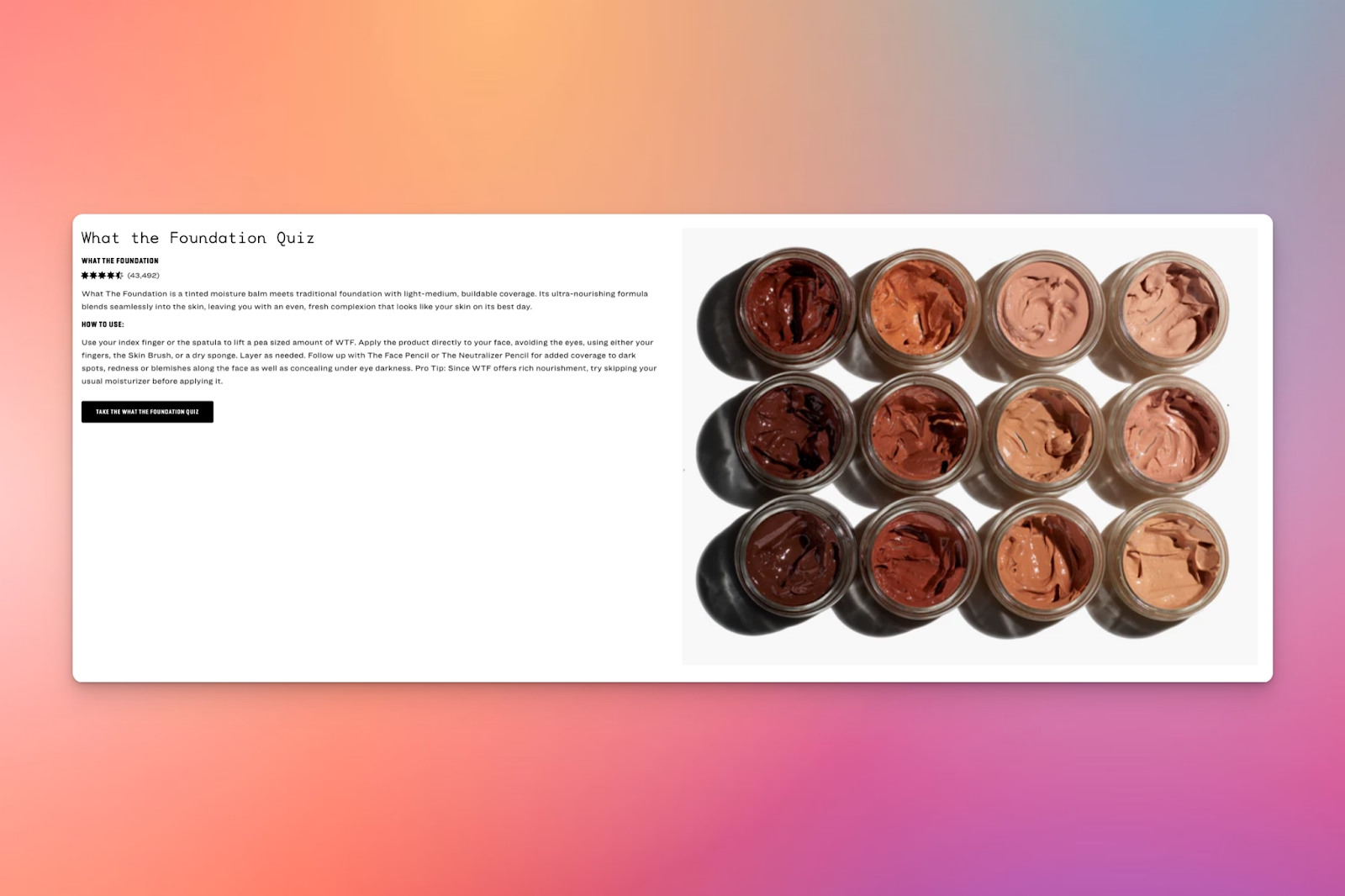
- Quizzes and polls, usually to generate product recommendations. These tend to guide customers to a solution while collecting data on their preferences, and can exist on your online store landing page.
- Interactive infographics in lead magnets that are clickable and educate customers on a problem or solution. Elements can include animations or input and output calculator tools.
- Live Q&A sessions that customers can hop on or leave whenever. It is a lower commitment for shoppers who don’t want to be present for the full session, and it can build trust between potential shopper and brand owner.
- User-generated content featured in the initial channel. This form of customer storytelling moves beyond basic testimonials, and usually comes in the form of simple 15-60 second video. It drives user engagement (such as comments, longer time spent on page, or more clicks), helps showcase product usage in a full journey narrative, and builds social proof among new audiences. In other words, it helps put a face to your content.
2. Organic Social Media Marketing
TikTok and Instagram are the two leading platforms for getting organic social media coverage about your brand and product, or for brands to start their own channels. At this stage in top of funnel marketing, the goal is to get as many eyeballs on your content as possible. Your two key metrics should be views and engagement. TikTok in particular prizes the following content elements:
- Trending audio integration that uses trending sounds within 24-48 hours for maximum reach
- Native content creation that signals authenticity are valued over polished, high-production videos
- Using a combination of 2-3 niche hashtags with 1-2 more broader trending hashtags allow for a more balanced mix for optimal discovery
- Driving engagement to your post within the first 30 minutes of a post can do wonders for boosting algorithm exposure
Instagram prioritizes the following content tactics:
- Brands should expand to using a multi-format strategy that uses a mix of photos, carousels, videos, and Stories for maximum reach.
- Using a collection of 5-10 targeted and highly relevant hashtags rather than the maximum 30 hashtags
- Leaning into cross platform integration by leveraging Instagram Shopping and linking directly to store product pages in posts or in brand bios. (Some brands even just make their homepage the product page to limit sources of distraction.)
- Authenticity is king. Remember to always share genuine brand stories and behind-the-scenes moments that help
3. Organic SEO Discovery
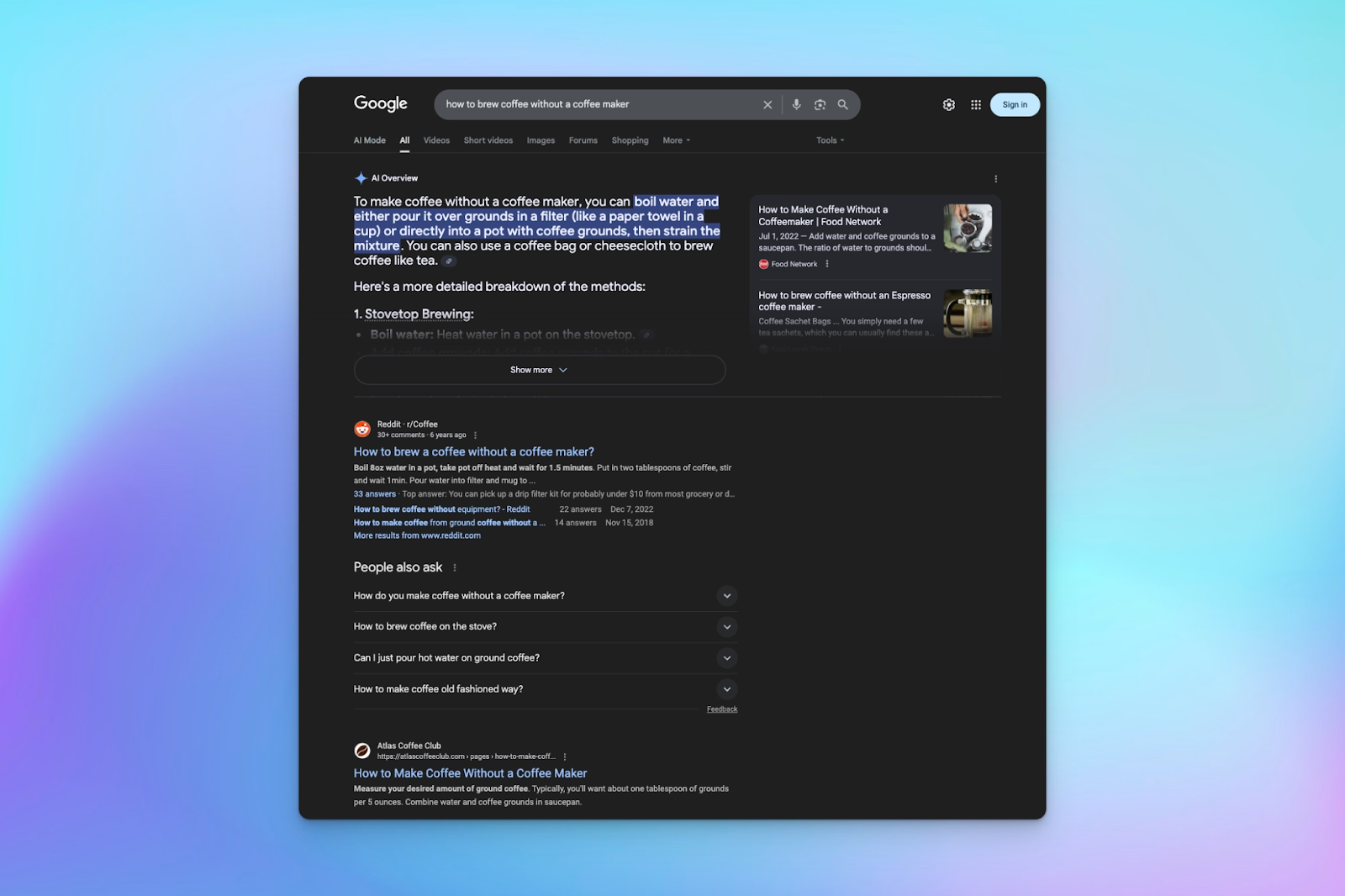
SEO (search engine optimization) determines how high a page ranks in search results whenever a shopper makes a relevant query. Ideally, a brand would want their results to rank number one for any relevant topics or questions related to their product or service. Here, brands are trying to drive traffic to educational or product-focused landing page types. Here are a few tactics to boost your SEO:
- Focus on conversational keywords that match the way people actually ask questions in real life. Think niche, long tail, question-based queries, such as “where is the nearest coffee shop?" or “how to cook salmon in 30 minutes?”
- To improve your chances of getting featured in Google’s Featured Snippet, make sure you include direct and concise 40-50 word answers to common questions related to the topic of that page.
- Make sure your pages are mobile optimized and load fast! Mobile search—and mobile online shopping—is only going to become more and more predominant. Largest content load times over 4 seconds are considered to be a bad user experience by Google. The slower your pages load, the higher your user bounce rates will be.
- Feature industry experts and thought leaders in your content to build trustworthiness in your long form content. Build further trust in your product or brand by displaying certifications, awards, and security badges across your site and marketing pages.
- Build authority for search engines by earning backlinks from reputable industry publications.
4. Influencer Partnerships
One of the most direct and natural ways to build awareness among audiences is by tapping into the social media influencers they follow. This includes micro-influencers and brand ambassador programs.
The former taps into highly targeted niche content for influencers with followings within the 10K to 100K range to drive higher engagement (such as likes and comments) at a lower cost per average post.
In fact, according to Sproutsocial, micro-influencers see a 6% engagement rate on Instagram, while mega-influencers see engagement rates around 1.97%. That’s a pretty big gap if you ask us.
On the other hand, brand ambassador programs work well for generating long term brand loyalty among audiences. Some tactics for brand ambassador partnerships include:
- Securing usage rights to influencer content across marketing channels
- Making sure brands involve their ambassadors as part of community building
- Using discount codes and affiliate links for attribution
5. Paid Advertising
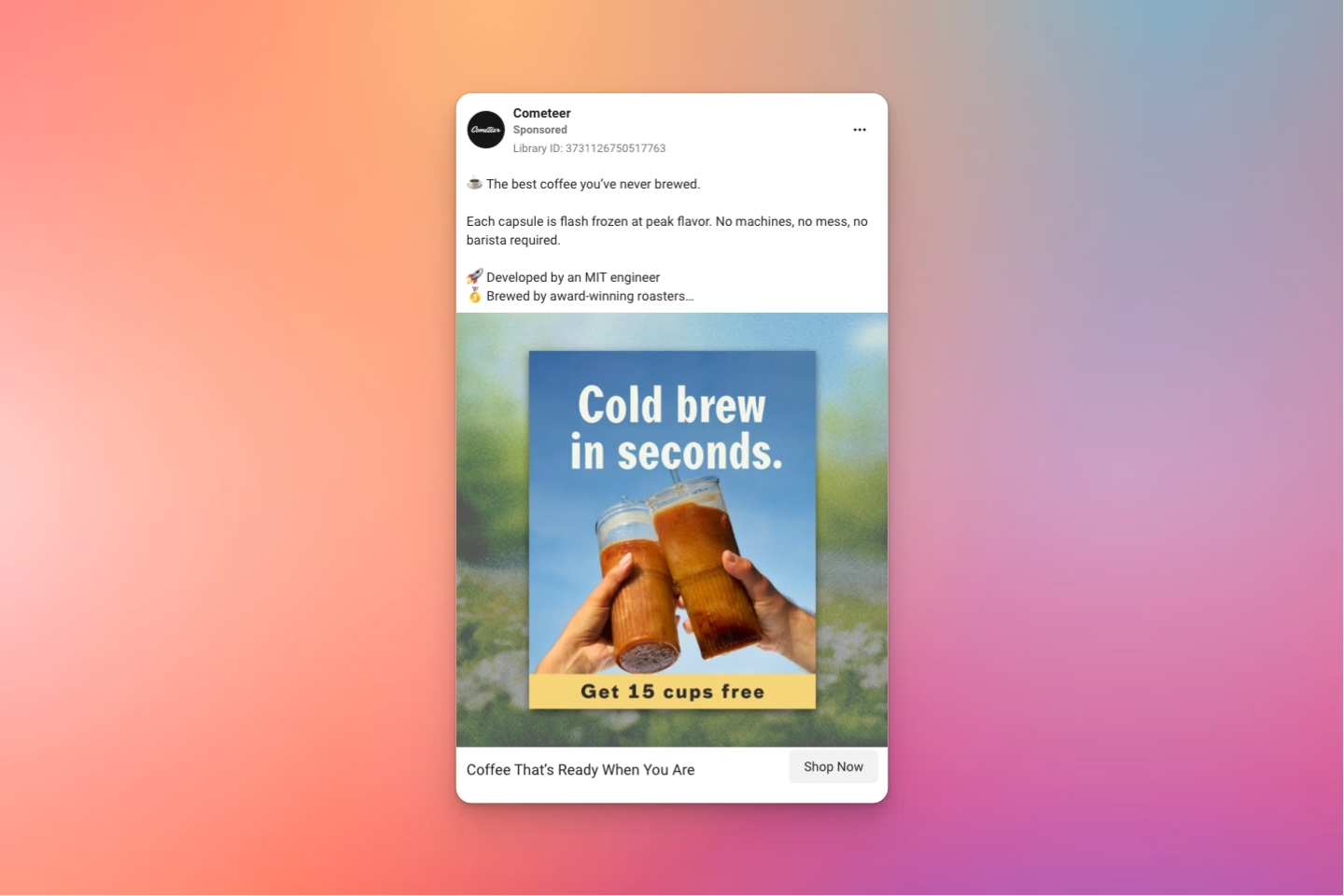
Meta and Google Ads are two of the biggest and most powerful platforms for ecommerce brands to reach potential customers through targeted advertising. Here’s some key tactics to look out for Meta Ads:
- Make sure you use automatic budget allocation across ad sets to get the optimal budget distribution
- Once you’ve established a core set of high-value customers on the platform, try using lookalike audiences to reach more audiences of that niche for higher performance
- Use dynamic creative testing to experiment with multiple ad variations automatically
- Finally, integrate your Facebook and Instagram campaigns, so you can use assets across platforms and get greater reach
Here’s some key tactics to look out for Google Ads:
- Test out Performance Max Campaigns, as this allows AI to optimize your campaigns for you
- Leverage video content across Google’s network with Youtube Ads Integration
- Use Smart Bidding to let the algorithm automatically bid for you; this leads to better ad performance and saves time
6. Community Building
Last but certainly not least, it’s important to build community around your brand and products. This does not mean preaching about your product in these communities or restricting the conversation to product-specific messaging. Rather, it means fostering an organic and educational conversation around the problem that your product is trying to solve. Building a community helps audiences develop familiarity with your brand, sets up your audience for future product education, and helps prime them on the importance of the value you can provide. In the short term, this is a great way to build awareness. In the long term, your brand communities will become your greatest source of high customer LTV—all while keeping new customer acquisition costs low. Here are some of our suggested strategies:
- Creating dedicated Discord servers for brand enthusiasts to engage in
- Building Facebook Groups to create private communities around shared interests
- Reddit Communities are also great areas for brands to participate in, though you will have to be careful to only deliver content that is directly relevant to the topic of the subreddit, and to stay authentic. Content that is openly sales-y will not perform well.
- In-real-life brand events or brand-sponsored events are worth considering if your brand has the resources and bandwidth to host one. When done right, in-real-life events can not only drive up engagement and awareness, but also serve as its own source of content.
Top Of Funnel Marketing Examples To Learn From
Our team observes hundreds of top of funnel marketing examples across a range of DTC brands on a daily basis.
Almost unanimously, the most common (and most-often recommended) playbook for a top of funnel marketing involves paid social advertising, usually Meta Ads or influencer Instagram ads, that drive to landing pages.
And for good reason—paid social advertising is the most direct, it’s the easiest to finetune the composition or reach of your target audience, and directing to landing pages delivers the most business impact by getting people from top of funnel to middle or bottom of funnel. (To build custom landing pages fast with the help of AI, check out our list of recommended AI tools.)
At the end of the day, it’s the route that leads to store revenue that matters the most.
We created a few unbranded examples of what these paid social ad flows look like, each modeled off a leading ecommerce brand.
Get inspiration from these examples, or access the full interactive Figma assets to see all marketing funnels.
Product Advertisement To Landing Page
Browse ready-to-run workflows in the Replo use case library.
This is the most common example of top of funnel marketing.
Brands use this method for catching audience attention, delivering their offer in a few succinct words, and getting them interested. This is also a best fit for brands that are currently trying to drive awareness and interest among unfamiliar audiences.
When a shopper clicks on the ad they get led to the ad offer landing page. The content on the landing page, no matter the type, should always be directly aligned with the content on the ad.
If the ad showcases a coffee product and messaging around an artistic or award-winning coffee ritual, then your landing page should feature the exact same messaging and imagery.
Browse ready-to-run workflows in the Replo use case library.
Content continuity tells audiences that they are in the right place. Your offer landing page should clarify your value proposition, add detail to the product, and build brand trust where consideration begins.
This cohesive messaging bridges your top of funnel marketing and your middle of funnel, which begins on the offer landing page.
Influencer Advertisement To Collections Page
The influencer ad leans into social proof by associating the brand’s products with a collaborating influencer.
This top of funnel marketing example taps into the influencers’ pre-existing audience, helping to boost awareness among new audiences. It also helps boost conversion rates among the new influencer-familiar audiences, given the influencer’s endorsement.
It’s important to note that influencers represented in this marketing funnel should have a background or niche that overlaps or is adjacent to the product that the brand is selling.
Influencer ads can be run on any channel, though increasingly, they are most often found on Instagram due to the platform’s highly visual nature.
Browse ready-to-run workflows in the Replo use case library.
Here, the shopper’s first interaction with your brand will be through the influencer promoting your product. Their introduction will set up expectations for what your product is for and why it is unique or beneficial to audiences.
When done right, the influencer should act as a figure of authority in their niche who can credibly communicate the value of your brand and extend an attractive offer.
To maintain content continuity, a CTA on the ad will lead audiences to a co-branded collections page which also features the influencer that was in the ad.
For example, you can have a fashion influencer wearing your products in a video ad on Instagram, explaining how followers who use her discount code to purchase items in your store can get 15% off.
The linked product detail page should be customized to feature her brand or account name—even better if you can include images of the influencer wearing your products across the page.
Browse ready-to-run workflows in the Replo use case library.
That’s a wrap for our guide today on top of funnel marketing! To learn more about middle of funnel or bottom of funnel marketing, check out the related articles below. To access the full interactive Figma file examples—covering top, middle, and bottom of funnel, with step by step assets—click on the link below.