Marketing
Lead magnet ideas
Five lead magnet ideas that work for online stores, with a real example of each: quizzes, samples, welcome offers, games and waitlists.
Start for freeLead magnet ideas for an online store, the free or cheap things you trade for a shopper's email, come down to five types. They are a product quiz, a cheap sample, a first-order offer, a game with a prize and a waitlist. Pick the one that answers the doubt that stops your shopper from buying. Replo, an AI landing page builder, builds the page that collects the email on your own store.
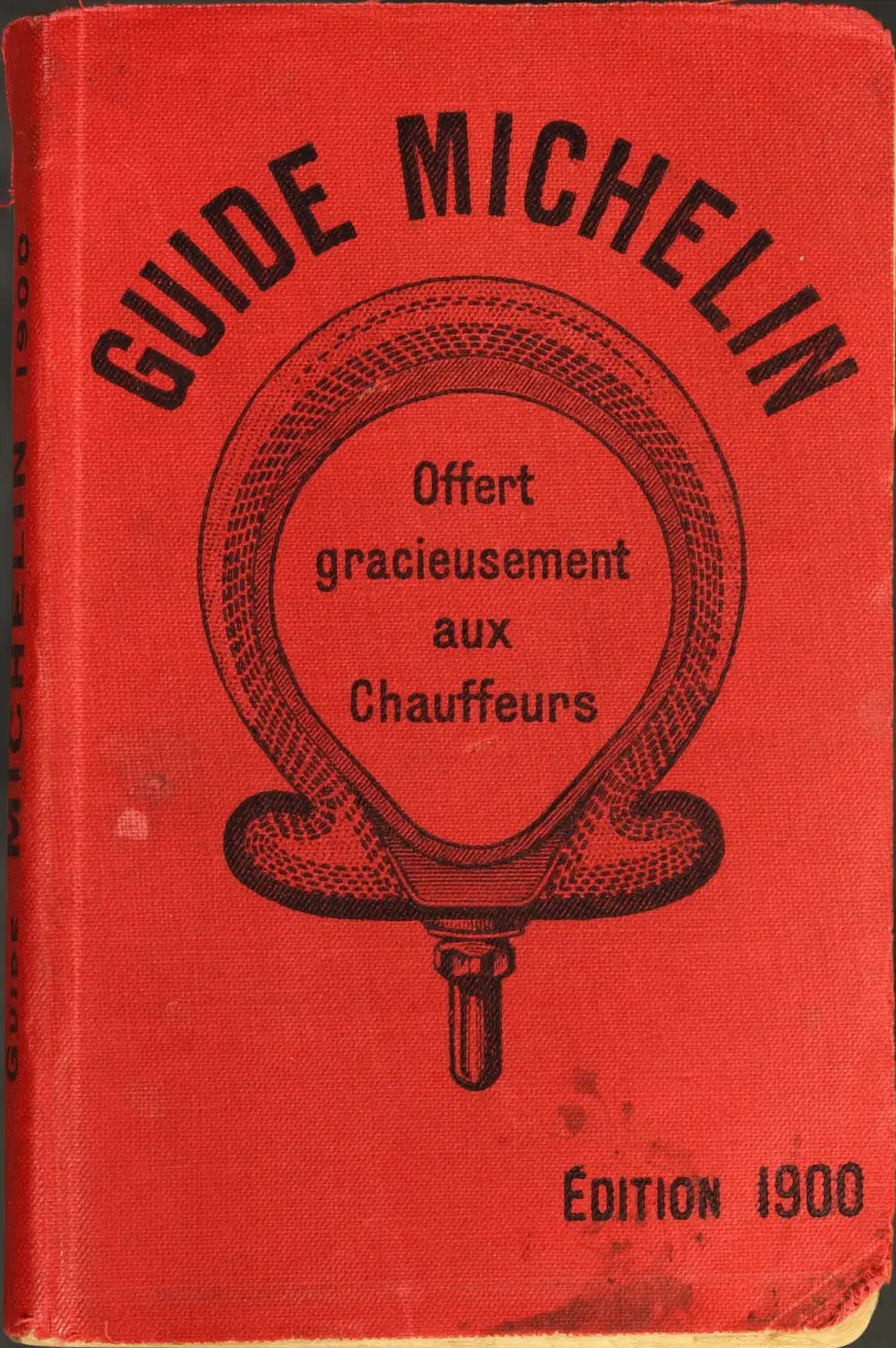
Michelin ran one of the first lead magnets. In 1900 the tire maker gave away nearly 35,000 copies of a red guide, when France had fewer than 3,000 cars. The guide listed mechanics, hotels and petrol stations, and showed drivers how to change a tire, because more driving meant more tires to sell. Michelin kept it free for two decades and started rating restaurants with stars in 1926.
A store's lead magnet does the same job on a smaller scale. You give the shopper something useful today, and you get a way to reach them when they're ready to buy. Below is a real example of each type, the Meta ad that sends people to it where there is one, and what to copy. Start free on Replo to build yours from a prompt or a page you like.
What are the types of lead magnets?
Five types fit online stores. Each one answers a different doubt, so pick by the question your shopper asks first.
| Lead magnet | Answers | Fits stores that sell |
|---|---|---|
| Product quiz | "Which one is for me?" | Shades, sizes, formulas |
| Sample or starter kit | "Will it work for me?" | Skincare, hair, food |
| First-order offer | "Is it worth the price?" | Repeat buys, subscriptions |
| Game or giveaway | "Why sign up today?" | Gifts, launches, sales |
| Waitlist or early access | "When can I get it?" | Drops, restocks, sales |
Quiz lead magnet examples
A quiz turns "which one is for me?" into a few taps. The shopper gives an email to see the answer. It suits a store with many shades, sizes or formulas.
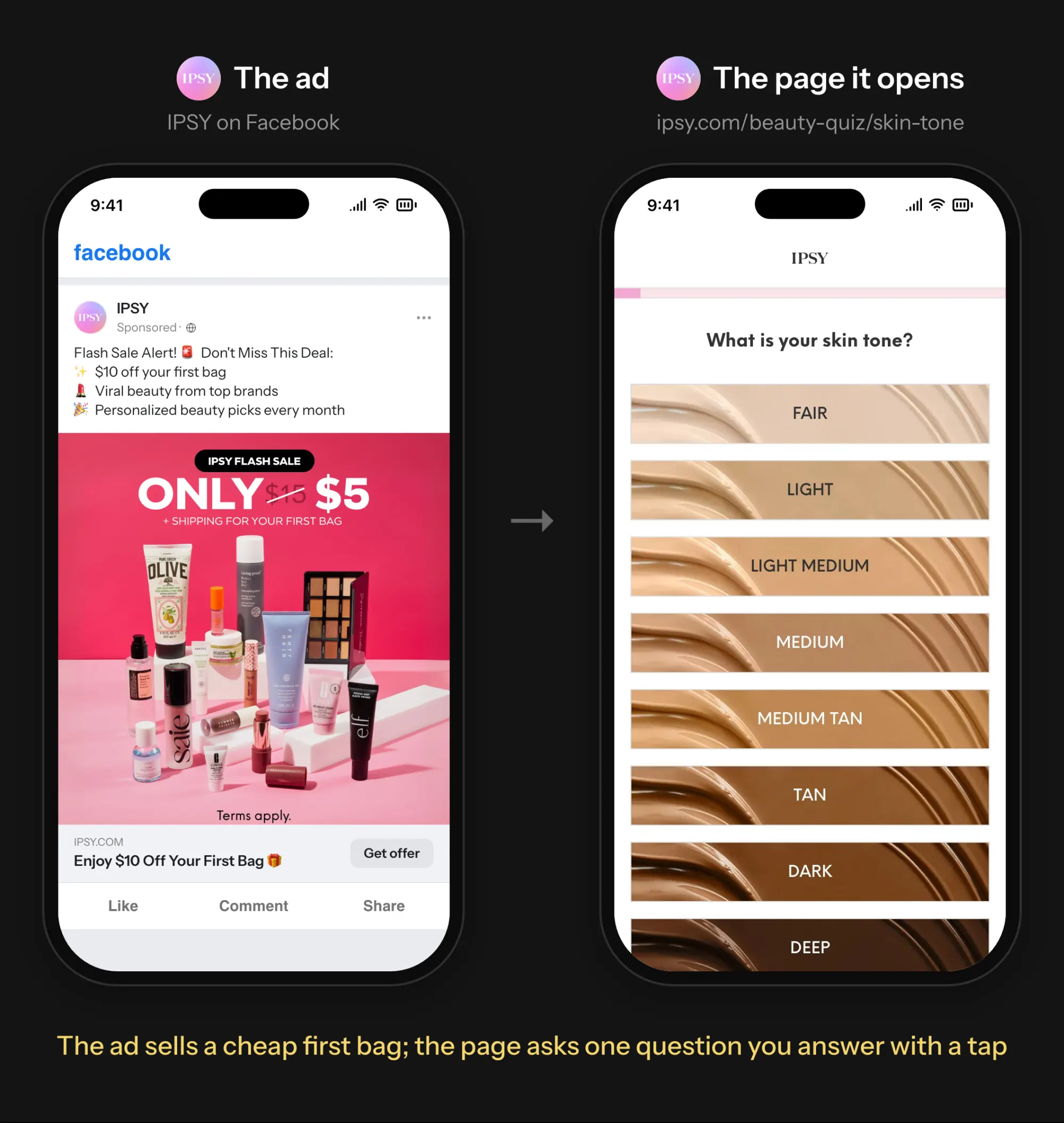
- IPSY (beauty). The ad offers a cheap first bag. The click opens a skin tone quiz with one question, eight buttons and nothing to read. IPSY runs six near-identical copies of this ad, a sign it is scaling a winner. See the ad in Meta's Ad Library.
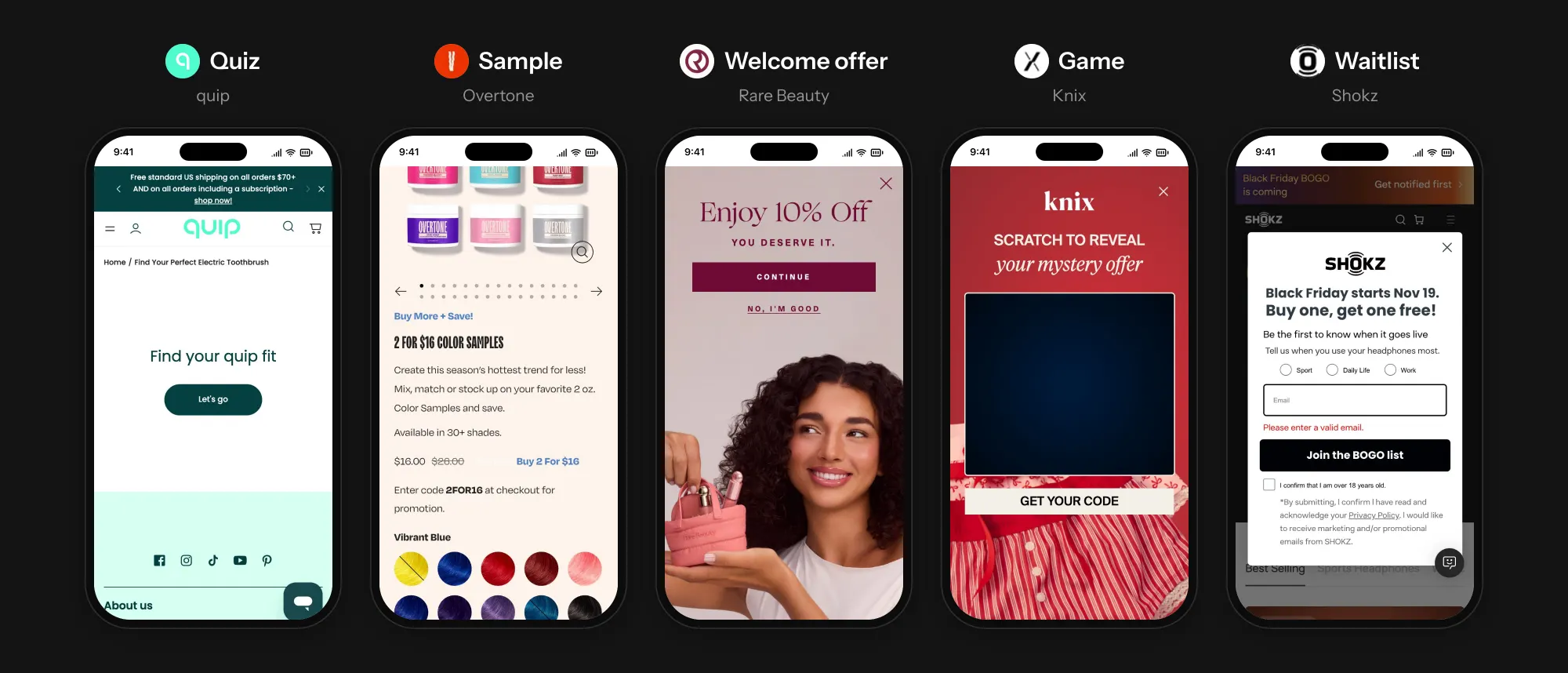
- quip (oral care). The page says "Find your quip fit" and has one "Let's go" button. quip sells several brushes, so the quiz picks one for you.
- Short Story (petite clothing). It runs a styling quiz for women 5'4" and under. Taking it tells the shopper the clothes are cut for her.
Make the first question the easiest one. Put the offer in the ad, so the quiz can start asking right away. Our quiz funnel examples show how each quiz hands the shopper to the product.
To build one like it, paste a quiz page you like. Replo shows what it does, then builds your version with your products behind each answer. Rebuild a competitor's best page.
Free sample and starter kit examples
A sample makes the first try cheap, and the order gives you a customer to follow up with. It suits products people need to feel, taste or see on their own skin.
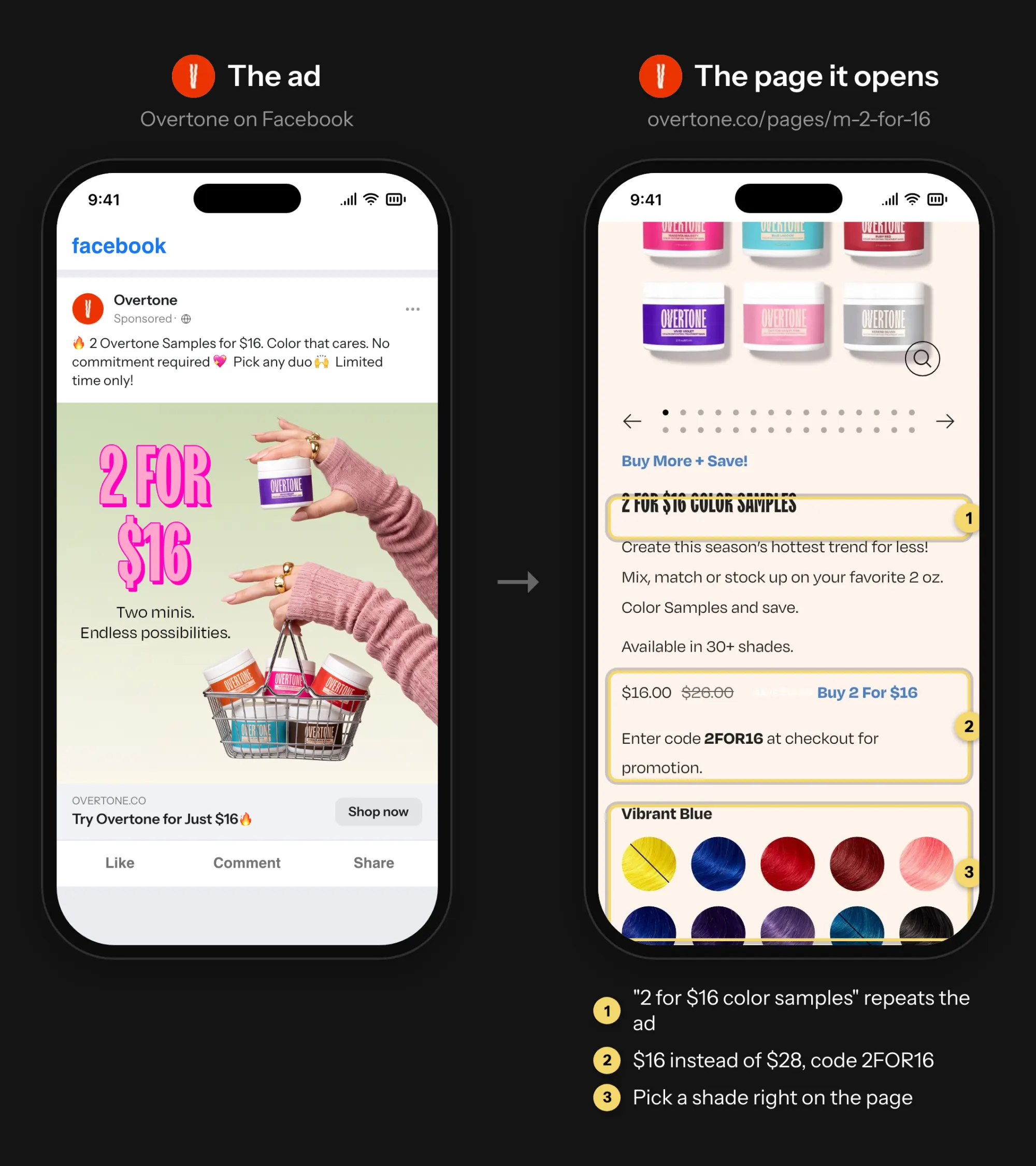
Overtone's hair color ad says "2 Overtone Samples for $16" over a basket of jars. The page opens on the same words and shows $16 against $28, with the code. Then it lets you pick any two of more than 30 shades. See the ad.
Name the price in the ad and again in the headline. Let the shopper choose what goes in the kit, so the sample already feels like theirs. Replo builds a kit or bundle page on your live Shopify catalog, priced with native discounts. Build a bundle page.
Welcome offer and discount examples
A first-order offer works when price is the doubt. The strongest ones put the deal in the headline.
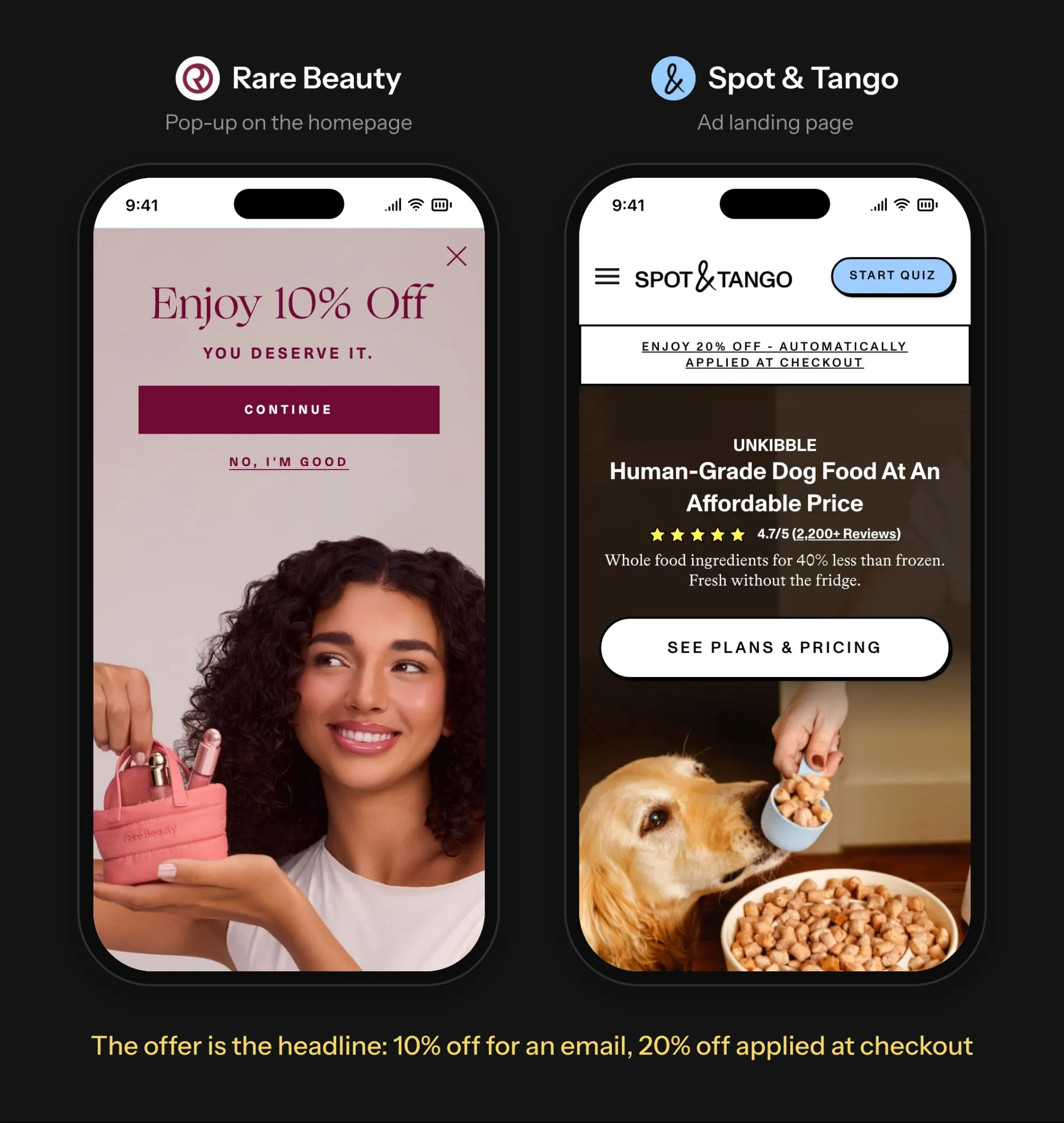
- Rare Beauty (makeup). The pop-up says "Enjoy 10% off" in big type. It has one Continue button and a polite "No, I'm good" to close it. One clear button is the core of any call to action.
- Spot & Tango (dog food). "Enjoy 20% off, automatically applied at checkout" sits above the headline. A 4.7-star rating and one button follow, and there is no code to remember.
A discount also reaches people who would have paid full price. Test the code against a quiz or a sample with an A/B test. Keep the one that brings more revenue per visitor, not the one that brings more emails. Our offer page examples show more.
Giveaway and game examples
A game gives shoppers a reason to sign up today, not someday. It suits gifts, launches and sales with a date.
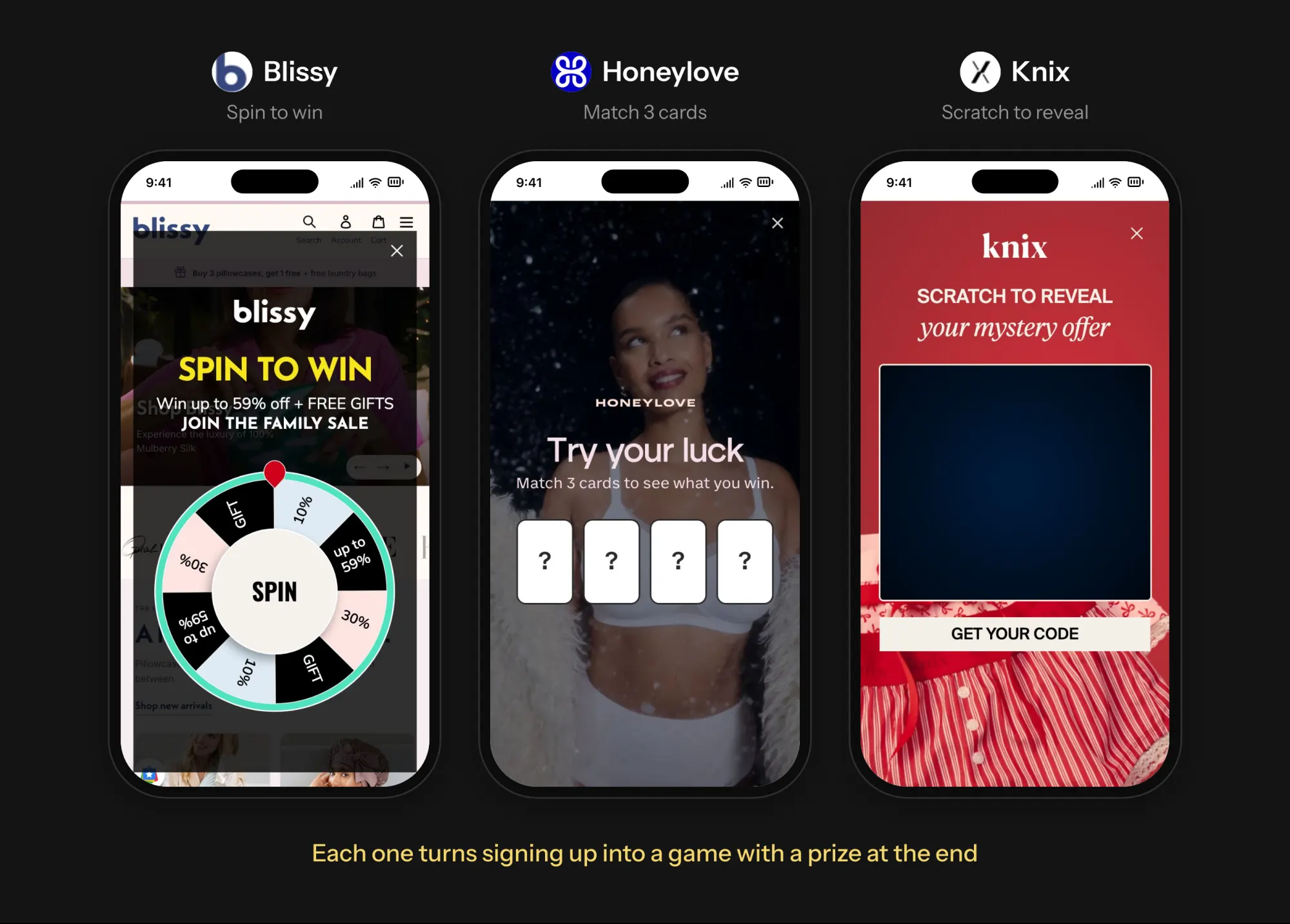
- Blissy (silk pillowcases). Its "Spin to win" wheel offers prizes from 10% off up to 59% off, plus free gifts.
- Honeylove (shapewear). Its "Try your luck" game asks you to match three cards to see what you win.
- Knix (underwear). Its pop-up says "Scratch to reveal your mystery offer", then shows one button to get the code.
Make every prize something from your store. A prize that has nothing to do with your product fills your list with people who wanted the prize.
Waitlist and early access examples
A waitlist collects demand before the stock or the sale arrives. It suits drops, restocks and a sale you announce ahead of time.
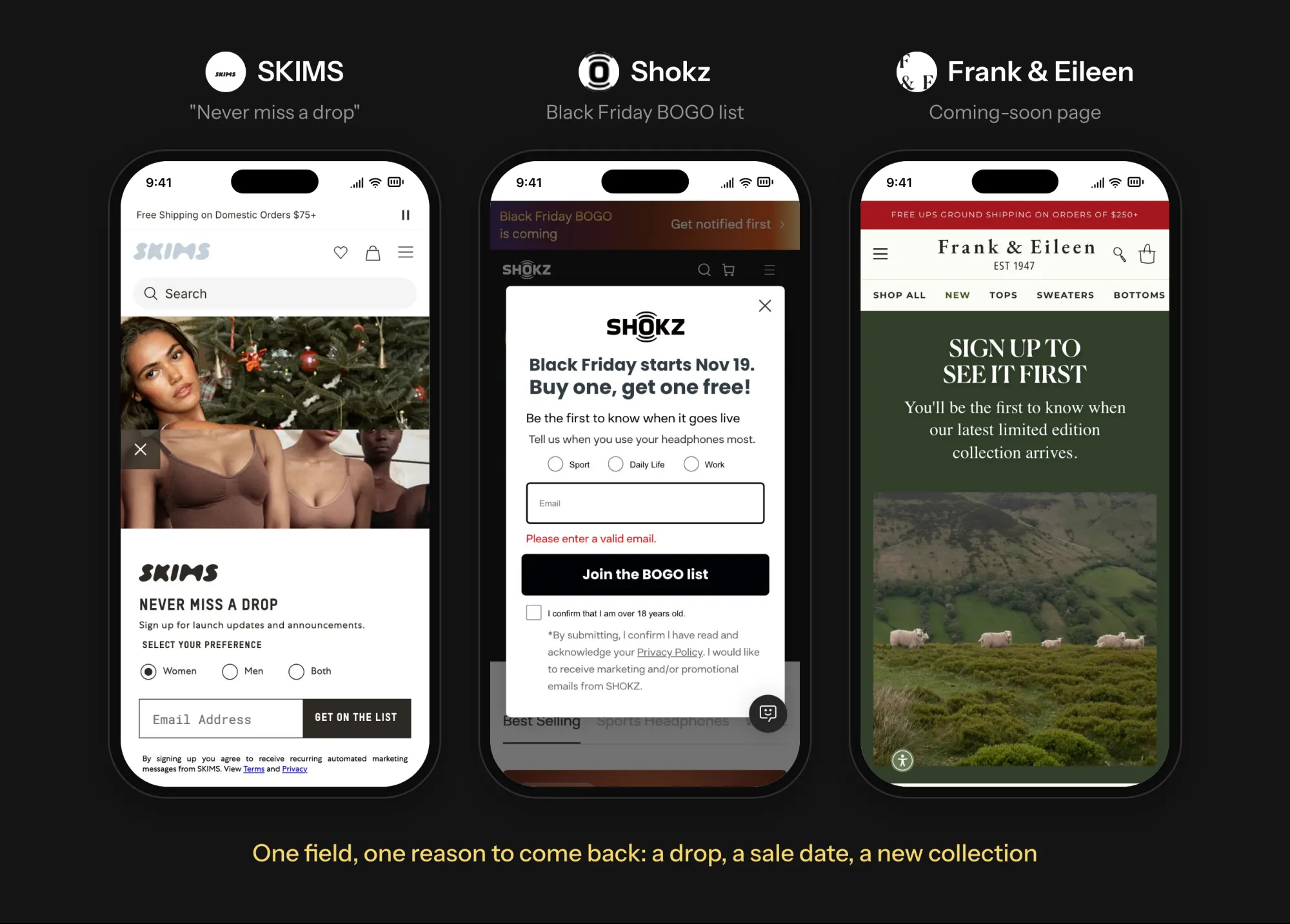
- SKIMS (clothing). The pop-up says "Never miss a drop." You tap women, men or both, then type an email.
- Shokz (headphones). It announces "Black Friday starts Nov 19. Buy one, get one free!" The pop-up asks how you use your headphones, so the sale email can match.
- Frank & Eileen (clothing). It runs a coming-soon page, "Sign up to see it first", for its next limited collection.
All three ask for one thing. Our lead capture funnel examples show more. Early-access sign-ups peak around Black Friday, so see the Black Friday ads brands are running and the pages they open. A small shop can run the same list for Small Business Saturday, the day after.
Do guides, checklists and webinars work for stores?
They work when the product needs explaining or the sale is slow. A store's guide earns its email when it teaches people to use the product. Think of a sizing guide, a kitchen brand's recipe pack or a skincare brand's routine. In our ad library, most report and guide sign-up pages belong to software companies, not stores.
Service and software businesses usually offer these lead magnets:
- A free trial, class or pass
- A free audit or consultation
- A report with numbers of your own
- A calculator with a personal result
How do you build a lead magnet funnel?
A lead magnet funnel runs from the ad to the sign-up page to the follow-up email. Build it in six steps:
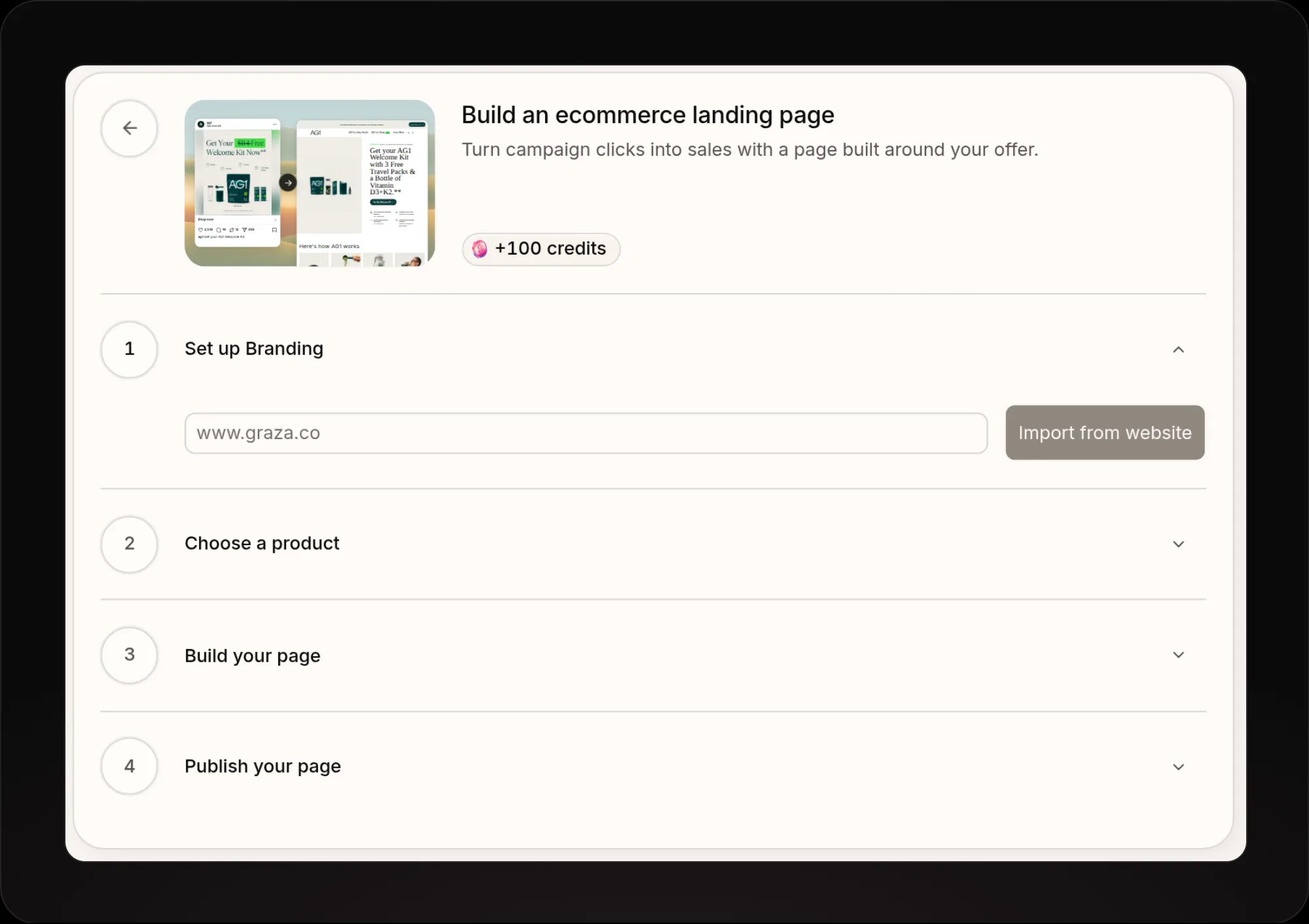
- Find the one doubt. Read your reviews and support tickets for the question shoppers ask before they buy.
- Pick the lead magnet that answers it. Use the table at the top of this post.
- Repeat the ad in the headline. Say what the ad promised in the same words, like Overtone's "2 for $16".
- Ask for one thing. Ask for an email or a phone number, not both, and drop the menu.
- Deliver it right away. Show the quiz result, code or confirmation on the next screen, then send it by email. Replo can draft the welcome email in Klaviyo for you to review and send. Still picking an email app? Small lists start with email marketing for small business; bigger ones can compare Klaviyo alternatives priced at 5,000 and 25,000 contacts.
- Test the page, then scale the ads. Run an A/B test on the offer, and use heatmaps to see whether people reach the field.
How do you know a lead magnet is working?
Track three numbers for each lead magnet page:
- Opt-in rate. Divide sign-ups by visitors. 120 sign-ups from 3,000 visitors is 4%.
- First-order rate. Count the share of those sign-ups who buy within 30 days.
- Revenue per visitor. Divide revenue from sign-ups by all visitors to the page.
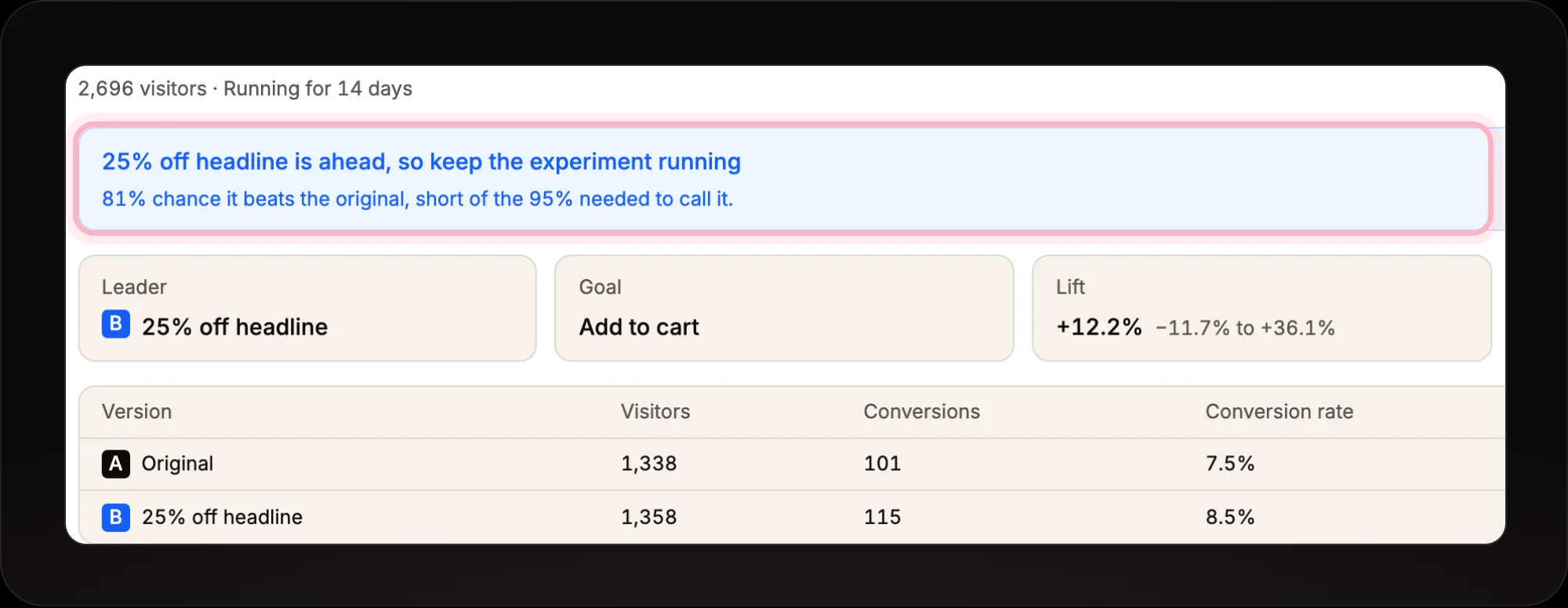
Judge the page on revenue per visitor. A quiz with fewer sign-ups can beat a discount if more of its sign-ups buy at full price. Our marketing funnel examples cover what happens after the email. Build your lead magnet page free on Replo.
Frequently asked questions
- What are some examples of lead magnets?
- For an online store, the common ones are a product quiz, a cheap sample kit, a first-order discount, a giveaway and a waitlist for a drop. A service or software business more often offers a free trial, an audit, a report or a calculator.
- Which lead magnet works best for an online store?
- The one that answers your shopper's first doubt. Use a quiz if they ask which product is right for them. Offer a sample if they doubt it works. Use a first-order offer if price is the doubt, and a waitlist if the product isn't out yet.
- Do discount lead magnets hurt margin?
- They can. A welcome code also goes to shoppers who would have paid full price. Limit the code to the first order, or test a quiz or sample against it. Keep whichever brings in more revenue per visitor.
- Should a lead magnet be a pop-up or its own page?
- Use both. A pop-up catches shoppers who are already on your store. Paid ads should open a page built for the offer, with the ad's headline, one field and nothing else to click.
- Can I build a lead magnet page on my own store?
- Yes. Describe the quiz, sample or offer, or paste a page you like, and Replo builds it on your brand with your products and your Shopify cart. You can split traffic between two versions and see where visitors tap before you scale the ads.