Contribution margin calculator
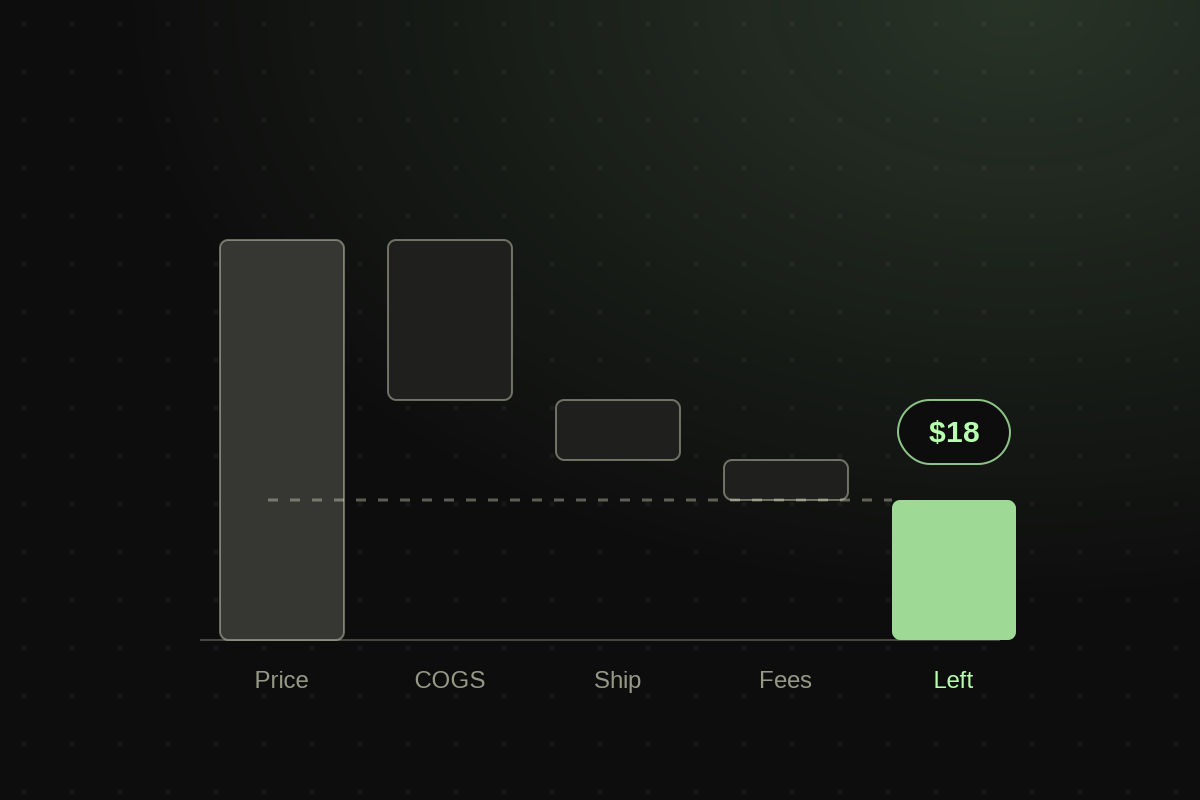
Contribution margin is what one order leaves after every cost that comes with it (product, shipping, payment fees, ads). That's the money that pays rent and salaries, then profit. Drag the order value and each cost on the waterfall to see it.
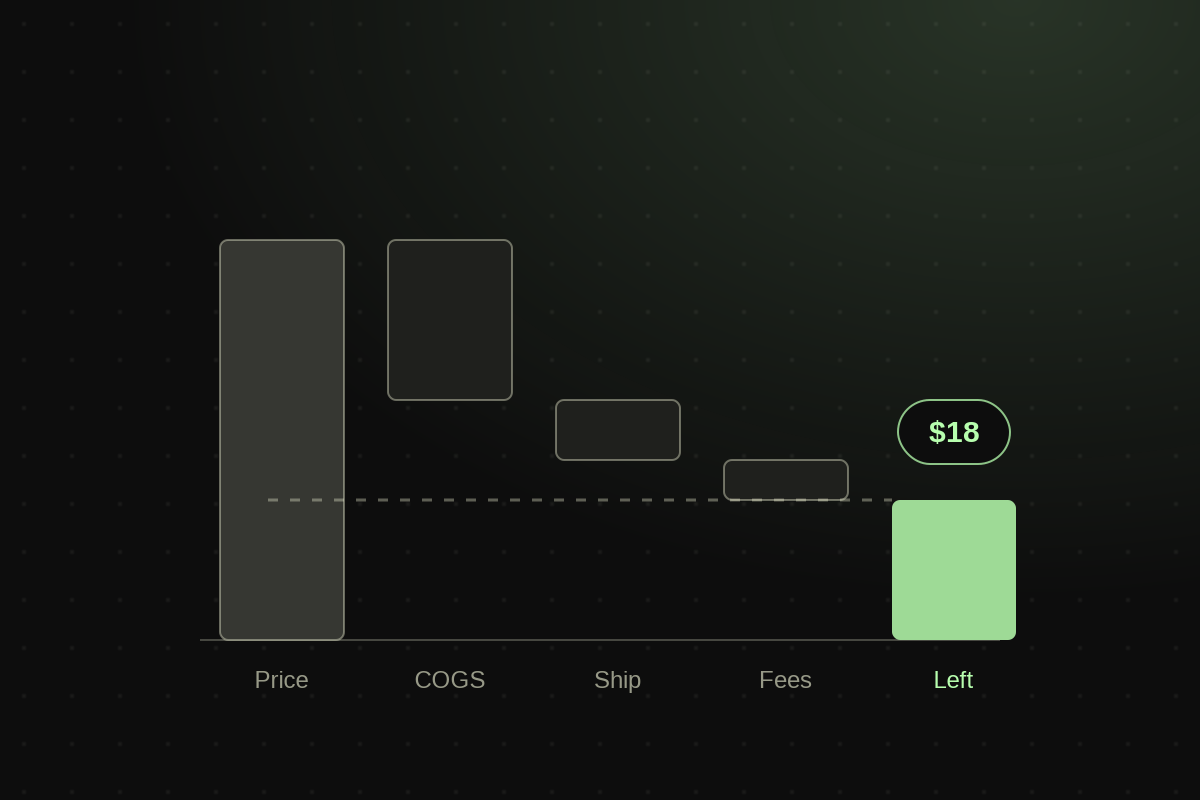
Contribution margin per order
$16.05
A $Average order value (AOV): your sales divided by your number of orders. $6,500 from 100 orders is a $65 AOV. order, less $What you paid for the items in an average order: manufacturing or wholesale cost, plus inbound freight. Often called COGS (cost of goods sold). of product, $Postage, boxes and pick-and-pack fees for one order, less any shipping the customer paid. Often $5–$12 in the US. to ship, %What your payment processor keeps from each order. Card fees are usually about 3% (2.9% plus 30¢ is common). in fees and $Your ad spend divided by your orders, also called CPA (cost per acquisition). Leave it at 0 to see the margin before ads. of ads, leaves $16.05 (24.7%) for fixed costs and profit.
Contribution margin is what one order leaves after every cost that comes with it (product, shipping, fees, ads). That's the money that pays rent, salaries and then profit.
With $Costs that stay the same however many orders you get: salaries, rent, software and subscriptions. of fixed costs a month, you need 748 orders a month to cover them.
- Contribution margin ratio
- 24.7%
- Before ads
- $34.05 (52.4%)
- Variable costs per order
- $48.95
- Most you can pay per order for ads
- $34.05
Drag the top of the order value, or the bottom of any cost, to resize it. Or type over any green number.
Get a daily report card for free. Replo has a daily report card of your business ready every morning, with what changed and why.
Every morning
Get your contribution margin in a daily report
Replo reads Shopify, Meta, Google Ads and Triple Whale and has your contribution margin ready every morning, with what changed since yesterday and why.

 Last week at Magic Spoon




Formula
Contribution margin is what an order leaves after its variable costs, such as product, shipping, fees and ads, to pay fixed costs and profit.
Contribution margin = order value − variable costs per order
Variable costs rise with every order: product cost, shipping, packing, payment fees and the ad cost of winning the order. Rent, salaries and software are fixed, so they stay out.
Other ways to calculate contribution margin
- Contribution margin ratio
- Contribution margin ratio = contribution margin ÷ order value × 100
- To compare products or channels with different order values.
- Orders to cover fixed costs
- Orders needed = fixed costs ÷ contribution margin per order
- To turn a month's rent, salaries and software into an order target.
How to calculate contribution margin: a worked example
A supplement store's average order is $65. Product cost is $20, shipping and packing $9, payment fees 3% and ads $18 per order.
- Payment fees = $65 × 3% = $1.95
- Contribution margin = $65 − $20 − $9 − $1.95 − $18 = $16.05
- Contribution margin ratio = $16.05 ÷ $65 = 24.7%
Each order leaves $16.05 to pay for the team, tools and profit.
What is a good contribution margin?
Positive is the first test: if an order loses money before fixed costs, more orders make it worse. After that, a good contribution margin is enough to cover fixed costs at the volume you can sell.
Orders needed per month = fixed costs ÷ contribution margin per order. With $12,000 of monthly fixed costs, the store above needs 748 orders a month to break even.
Do it with Replo
Track contribution margin per order
Replo combines Shopify costs and ad spend into one daily report of what each order leaves.
Prompt: “email me contribution margin per order every morning”
Questions about contribution margin
- What is contribution margin?
- Contribution margin is the money a sale leaves after its variable costs, the ones that come with every order: product, shipping, payment fees and ads. A $65 order with $45 of those costs contributes $20 toward fixed costs and profit.
- How do you calculate contribution margin?
- Subtract variable costs from the order value: contribution margin = order value − (product + shipping + fees + ad cost per order). Divide by order value for the contribution margin ratio.
- Is contribution margin the same as gross margin?
- No. Gross margin subtracts only the product cost. Contribution margin also subtracts shipping, fees and ad cost per order, so it shows what an order really leaves. It's the better number for deciding how much to spend on ads.
- Should I include ad spend?
- Yes, for paid orders. Ads are a cost of winning each order, so include your cost per order. Some stores track two numbers: contribution before ads and after ads, to see what organic and paid orders each leave.
- How do I raise contribution margin?
- Raise the order value with bundles, cut shipping cost per order by shipping more items together, and lower the ad cost per order with pages that convert better. Each of these works without touching your fixed costs.