Break-even point calculator
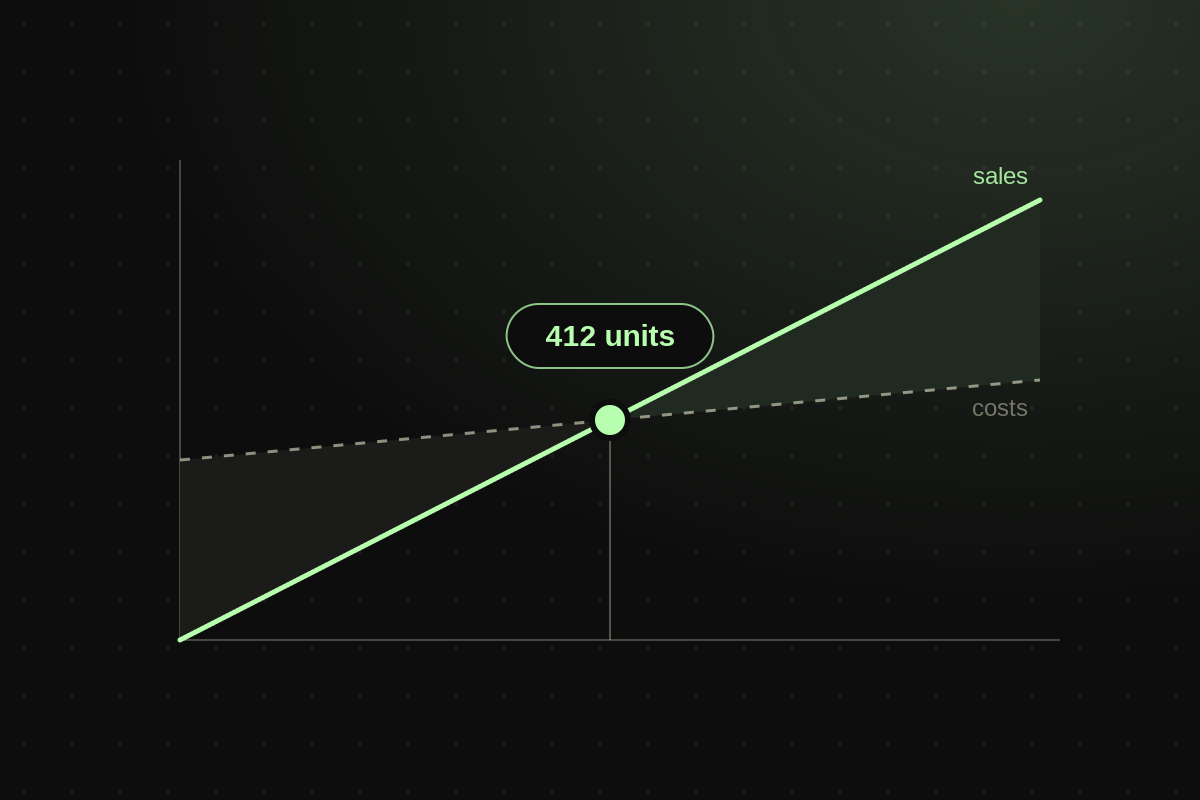
Your break-even point is how much you need to sell each month before you stop losing money. Drag the cost and revenue lines to your fixed costs, unit cost and price: where they cross is the number of units you need.
Break-even units per month
556
$Costs that stay the same however much you sell: salaries, rent, software, subscriptions and loan payments. of fixed costs a month, a $What a customer pays for one unit, before tax. Use your average selling price after discounts. price and $Costs that come with every unit sold: the product, packing, shipping, payment fees and ad spend per order. to make, ship and sell each one. You need 556 units ($22,240 in sales) a month to cover costs.
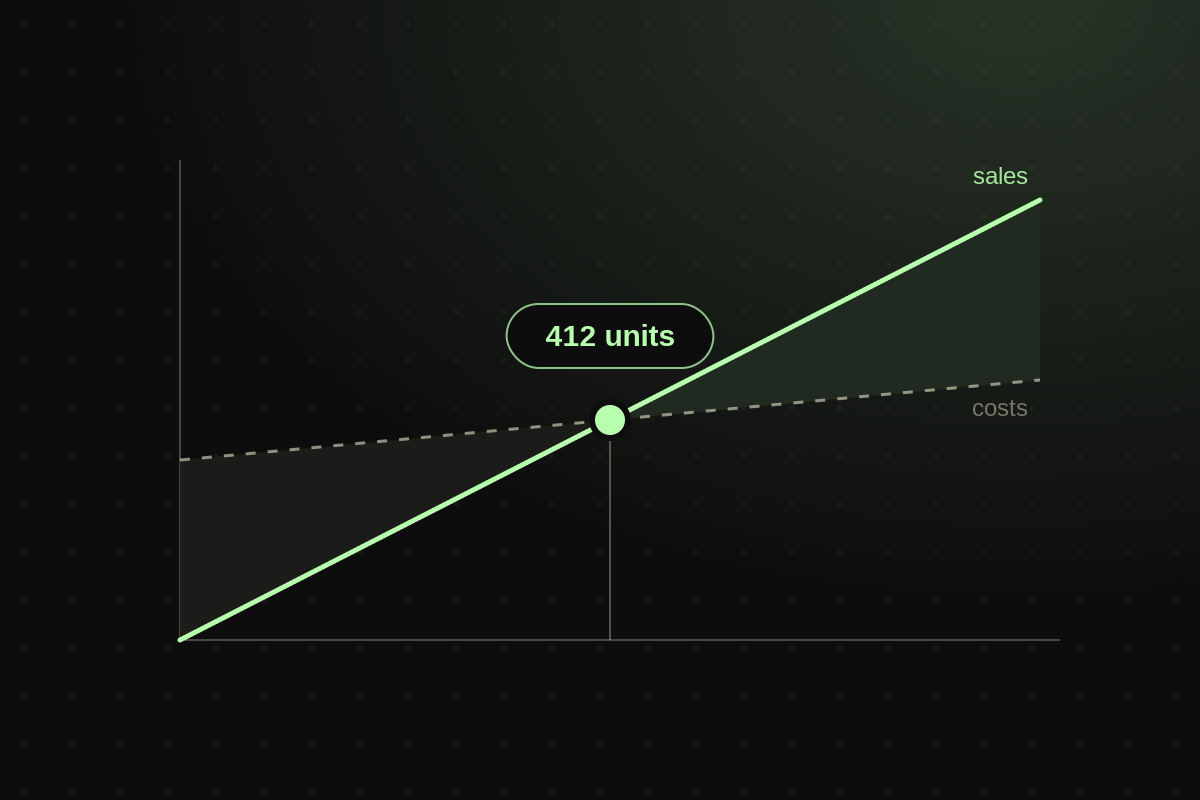
The break-even point is how much you need to sell before you stop losing money. It's where the money coming in (green) catches up with your costs (dashed).
- Revenue: $40.00 a unit
- Costs: $10,000 fixed plus $22.00 a unit
- Profit
- Loss
- Break-even revenue a month
- $22,240
- Contribution per unit
- $18.00 (45.0%)
- Profit at 800 units
- $4,400
- Units per day to break even
- 18.5
Drag the cost line's left end to set fixed costs, either line's right end to set price or unit cost, and the green marker to your expected sales. Or tap any green box to type a number.

 Last week at Magic Spoon
Get a daily report card for free. Replo has a daily report card of your business ready every morning, with what changed and why.
Every morning
Get your break-even in a daily report
Replo reads Shopify, Meta, Google Ads and Triple Whale and has your break-even ready every morning, with what changed since yesterday and why.




Formula
The break-even point is the number of units, or the sales, at which revenue covers all your costs and profit is zero.
Break-even units = fixed costs ÷ (price − variable cost per unit)
Price minus variable cost is what each unit contributes. Fixed costs are what you pay no matter how much you sell: rent, salaries, software, insurance.
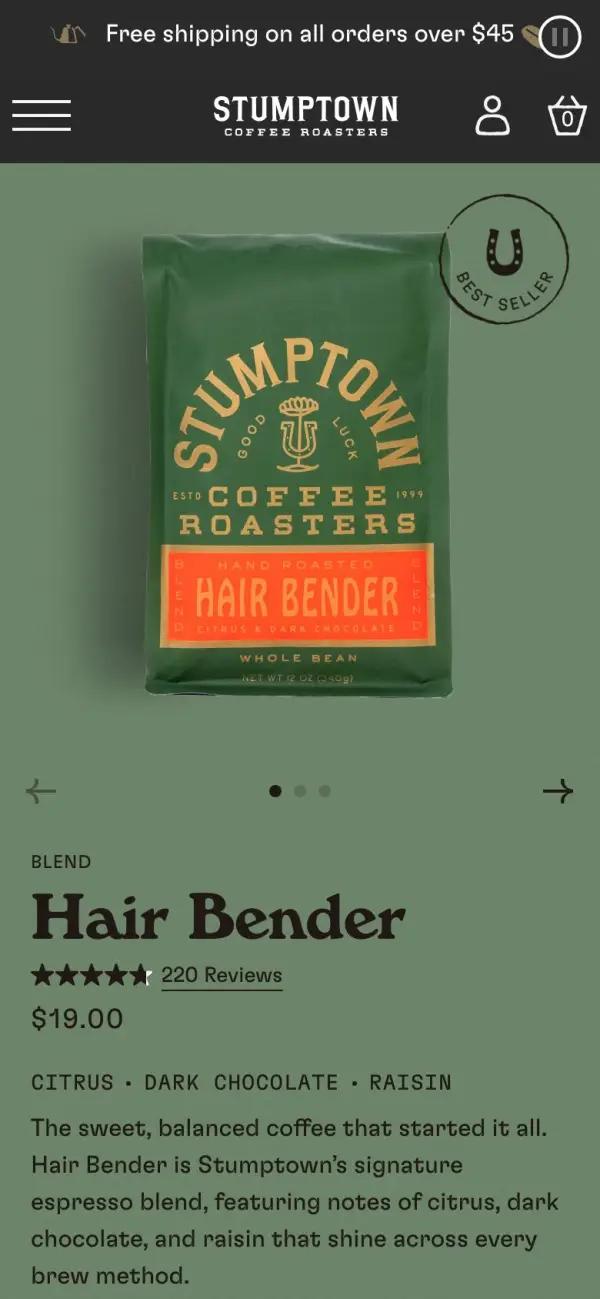
 Stumptown Coffee Roasters
Hair Bender coffee, 12 oz, $19
Stumptown's Hair Bender sells for $19.00. A 60% margin at that price means a cost of $7.60 or less; a 100% markup (keystone) means a $9.50 cost.
See the live pageOther ways to calculate break-even point
- Break-even revenue
- Break-even revenue = fixed costs ÷ contribution margin ratio
- When you plan in sales dollars rather than units, or sell many products.
- Units for a profit target
- Units = (fixed costs + target profit) ÷ (price − variable cost)
- When you need a profit on top of covering costs.
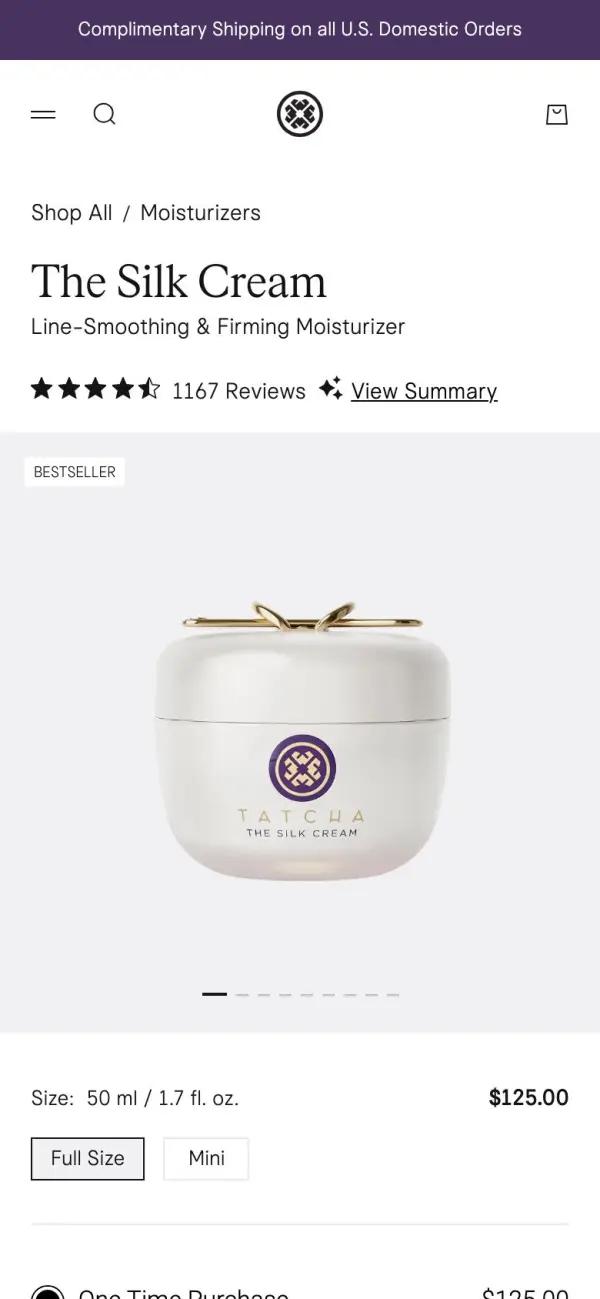
 Tatcha
The Silk Cream, 50 ml, $125
Tatcha's Silk Cream sells for $125.00. A 60% margin at that price means a cost of $50.00 or less; a 100% markup (keystone) means a $62.50 cost.
See the live pageHow to calculate break-even point: a worked example
Stanley sells its 20 oz Quencher for $40. Say you sell a tumbler at that price, each unit costs $22 to make, ship and sell, and your fixed costs are $10,000 a month.
- Contribution per unit = $40 − $22 = $18
- Break-even units = $10,000 ÷ $18 = 556 a month
- Break-even sales = 556 × $40 = $22,240 a month
You need about 19 sales a day before you make a dollar of profit.
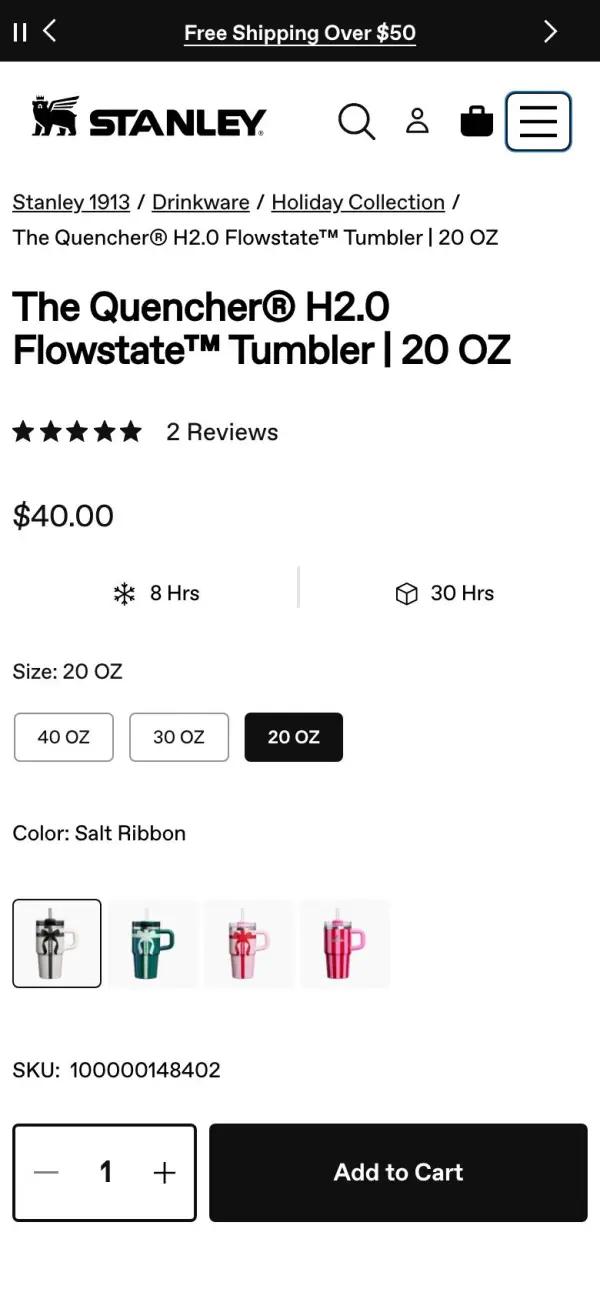
 Stanley 1913
Quencher H2.0 tumbler, 20 oz, $40
Stanley's Quencher sells for $40.00. A 60% margin at that price means a cost of $16.00 or less; a 100% markup (keystone) means a $20.00 cost.
See the live pageWhat is a good break-even point?
One you clear with room to spare. Margin of safety = (units you sell − break-even units) ÷ units you sell. It's how far sales can fall before you lose money.
If the store above sells 700 units a month, its margin of safety is (700 − 556) ÷ 700 = 20.6%. A slow month of 20% fewer sales would still break even.
Do it with Replo
Start selling and cover costs sooner
Describe your product. Replo builds the store with checkout working, so your first sales start covering costs.
Questions about break-even point
Divide fixed costs by what each unit leaves after its variable costs: break-even units = fixed costs ÷ (price − variable cost per unit). $10,000 of monthly costs at a $40 price and $22 unit cost needs 556 units a month.
A fixed cost stays the same whether you sell 10 units or 1,000: rent, salaries, software subscriptions, insurance and loan payments. Costs that rise with each sale, like product cost, shipping and payment fees, are variable.
Either place works if you're consistent. If you spend a set budget each month, treat it as fixed. If you pay per order, add your cost per order to the variable cost of each unit.
Raise the price, lower the cost per unit or cut fixed costs. A higher price usually moves it most: in the example, a $45 price drops break-even from 556 to 435 units a month.