CPA calculator
Cost per acquisition (CPA) is what your ads cost for each order they bring in: $3,000 for 75 orders is $40. Drag the point to set spend and orders, then drag the line to your margin to see whether the first order pays for itself.
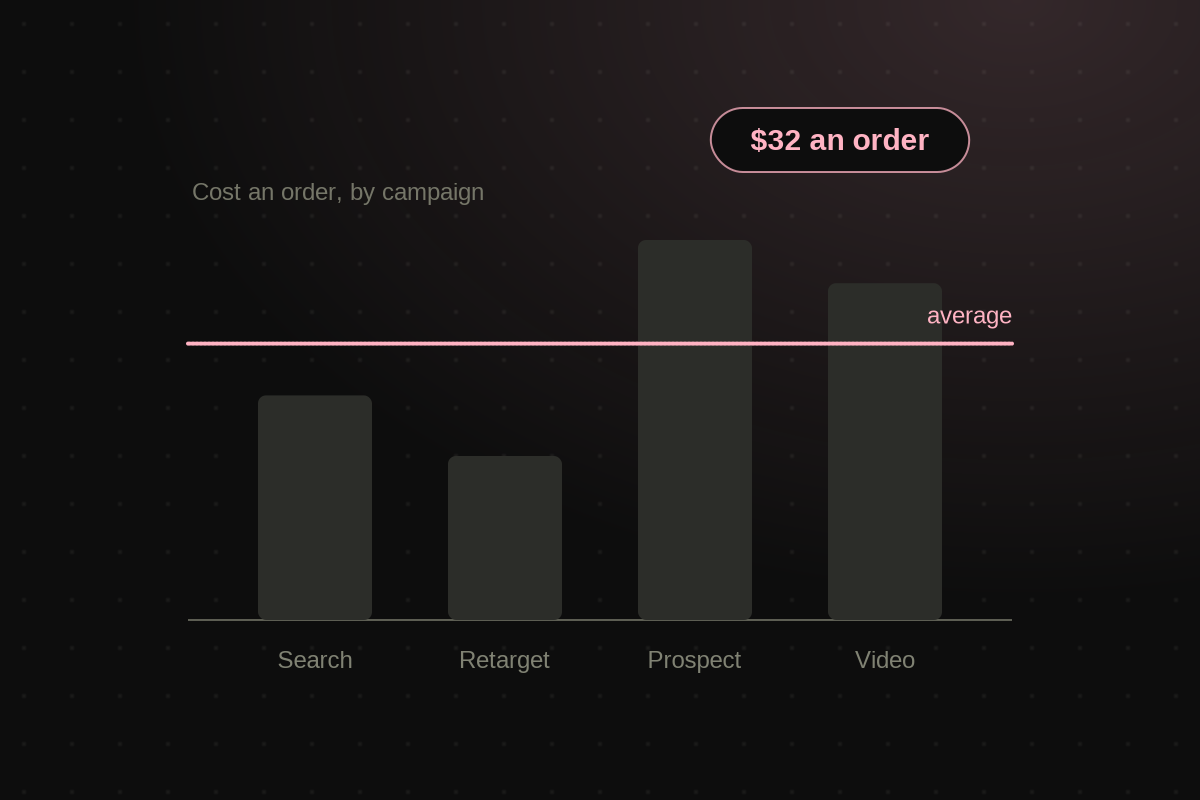
Cost per acquisition
$40.00
Losing money$What the ad platform billed you for the period, such as the last 30 days. brought in Orders credited to these ads over the same dates. Ad platforms call them purchases, results or conversions. orders. Each $Average order value (AOV): your sales divided by your number of orders. $7,000 from 100 orders is a $70 AOV. order at a %The share of each order left after product cost, shipping and payment fees. Most online stores: 40–70%. margin leaves $38.50, so you lose $1.50 on each first order.
Cost per acquisition (CPA) is what your ads cost for each order they bring in. An order pays for itself when its margin covers that cost.
- You: $40.00 each
- Your $3,000 spread over more or fewer orders
- An order leaves $38.50 at a 55% margin (drag it)
- Below the line: each pays for itself
- Above: each costs more than it earns
- Break-even CPA
- $38.50
- Profit or loss per first order
- -$1.50
- Orders to break even on this spend
- 78
- ROAS at this CPA
- 1.75x
Drag the green dot to set orders and spend. Drag the dashed line to change your margin. Or type over any green number.
Find trends in your business for free. Ask a question about your store and Replo answers it from every tool you connect.
Every morning
Get your CPA in a daily report
Replo reads Meta, Google Ads, TikTok, Shopify, Google Analytics 4 and Triple Whale and has your CPA ready every morning, with what changed since yesterday and why.

 Last week at Magic Spoon






Formula
Cost per acquisition (CPA) is what you spend on ads for each order or other conversion they bring in.
CPA = ad spend ÷ conversions
For a store, a conversion is usually an order. Break-even CPA = average order value × gross margin, the gross profit one order leaves.
Other ways to calculate CPA
- CPA from CPC and conversion rate
- CPA = CPC ÷ conversion rate
- To see whether a high CPA comes from the ad or from the page it sends people to.
- Break-even CPA
- Break-even CPA = order value × gross margin
- To find the most a first order can cost in ads before it loses money.
How to calculate CPA: a worked example
A store spends $3,000 on ads and gets 75 orders. The average order is $70 and the gross margin is 55%.
- CPA = $3,000 ÷ 75 = $40
- Break-even CPA = $70 × 55% = $38.50
- Each first order loses $40 − $38.50 = $1.50
The first order almost pays for itself. If customers come back, the campaign likely makes money; if they don't, it loses a little on every sale.
What is a good CPA?
A good CPA is below what an order leaves you in gross profit. If you can wait for repeat orders, the ceiling rises to the gross profit a customer brings over their lifetime.
Work out both numbers: first-order break-even (order value × margin) and lifetime break-even (from the LTV calculator). A CPA between the two pays back only if customers reorder.
Do it with Replo
Get CPA by campaign every Monday
Replo pulls spend and orders, works out CPA for each campaign and emails you the report.
Prompt: “email me CPA by campaign every Monday”
Questions about CPA
- How do you calculate CPA?
- Divide ad spend by the orders those ads brought in: CPA = ad spend ÷ orders. $3,000 of ads that drove 75 orders is a $40 CPA. Compare it with what an order leaves after costs to see if it's profitable.
- What's the difference between CPA and CAC?
- CPA counts ad spend per conversion, and a conversion can be any action, including repeat orders. CAC counts all sales and marketing spend per new customer. CAC is the stricter number for deciding whether growth pays.
- Why is my CPA higher in Shopify than in Meta?
- Meta counts orders it can link to an ad inside its attribution window, which Shopify may credit elsewhere. Dividing spend by fewer credited orders gives a higher CPA. Pick one source and compare it with itself over time.
- How do I lower CPA?
- Raise the share of clicks that buy. A page that matches the ad's offer, loads fast and answers objections lowers CPA without touching the ad budget, and it works for every campaign pointing there.