Customer acquisition cost calculator
Customer acquisition cost (CAC) is what you spend on marketing for each new customer you win: $15,000 for 320 customers is about $47. Drag the point to set spend and new customers, then drag the line to what a customer is worth to see if you're paying too much.
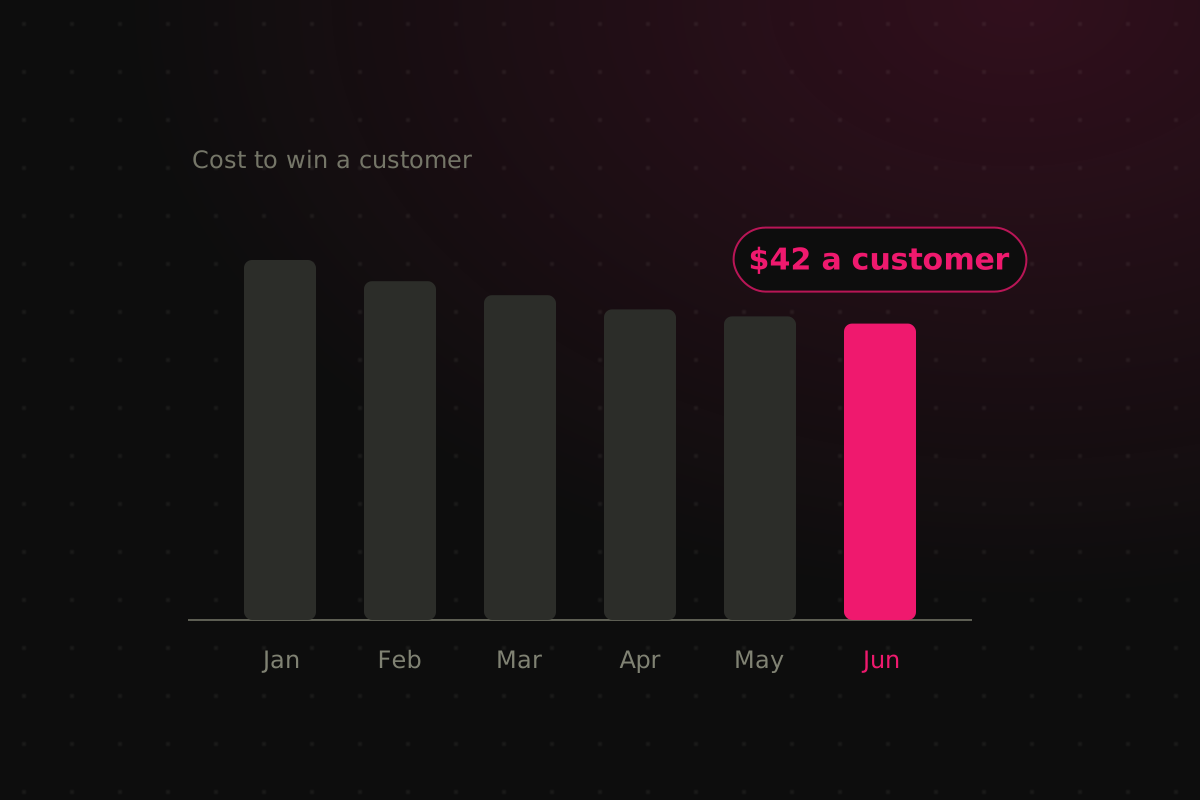
Customer acquisition cost
$46.88
Profitable$Everything you spent to win customers in the period: ads, influencers, affiliate payouts, agency fees and promo tools. won People who placed their first order in the same period. Don't count repeat buyers. new customers. Each is worth $Lifetime value (LTV): the gross profit a customer brings over every order they ever place. Work it out with the LTV calculator; $100–$300 is common for stores with repeat buyers. in lifetime gross profit, so each returns 3.0x what it cost.
Customer acquisition cost (CAC) is everything you spend on marketing divided by the new customers it won. It's fine to pay a lot for a customer who buys again and again.
- You: $46.88 each
- Your $15,000 spread over more or fewer customers
- A customer is worth $140.00 in lifetime profit (drag it)
- Below the line: each pays for itself
- Above: each costs more than it earns
- LTV to CAC
- 2.99 : 1
- Profit per customer after CAC
- $93.13
- Customers per $1,000
- 21.3
- Most you can pay for 3 : 1
- $46.67
Drag the green dot to set new customers and spend. Drag the dashed line to change what a customer is worth. Or type over any green number.
Find trends in your business for free. Ask a question about your store and Replo answers it from every tool you connect.
How to read your number
CAC is your marketing spend divided by the new customers it won: $15,000 for 320 customers is $46.88 each. It's good when it's below the gross profit a customer brings you. If yours is close to or above that, fix how many visitors buy before you spend more to reach new ones.
Why it matters
CAC decides whether growth makes money or burns it. If a customer is worth $140 in gross profit and costs $47 to win, every new one adds about $93; at $150 to win, every new one loses $10. Knowing it tells you how much you can afford to spend to grow.
Every morning
Get your customer acquisition cost in a daily report
Replo reads Shopify, Klaviyo, Recharge and Triple Whale and has your customer acquisition cost ready every morning, with what changed since yesterday and why.

 Last week at Magic Spoon




Formula
CAC = sales and marketing spend ÷ new customers
Count every cost of winning customers in the period: ad spend, agency and creator fees, first-order discounts and marketing tools. Count only first-time buyers, not repeat orders.
Other ways to calculate customer acquisition cost
- Paid CAC
- Paid CAC = ad spend ÷ new customers from ads
- To judge ad channels on their own, without content, email or team costs.
- LTV to CAC
- LTV to CAC = lifetime gross profit per customer ÷ CAC
- To see how many times over a customer pays back what they cost.
What is customer acquisition cost?
Customer acquisition cost, or CAC, is what you spend to win one new customer. If you spend $15,000 on marketing in a quarter and 320 people buy from you for the first time, your CAC is $46.88.
It's the other half of customer lifetime value. Lifetime value says what a customer is worth; CAC says what they cost. Together they tell you whether spending more on growth makes money.
How do you calculate CAC?
- Pick a period. A month or a quarter. Longer periods smooth out launches and sales.
- Add up what you spent to win customers. Ad spend, agency and creator fees, influencer product, first-order discounts and marketing tools: $15,000.
- Count new customers. First-time buyers only: 320.
- Divide spend by customers. $15,000 ÷ 320 = $46.88.
Two choices change the answer, so decide them once.
Blended or paid. Blended CAC divides all marketing spend by all new customers, including those who found you through search or word of mouth. Paid CAC divides ad spend by the customers ads brought in. Blended is lower; paid tells you what ads really cost.
What spend counts. Including salaries and tools gives a fuller CAC. Ad spend alone gives something closer to CPA. Either works if you keep the same rule each time.
How to calculate customer acquisition cost: a worked example
A store spends $15,000 on marketing in a quarter and wins 320 new customers. Each customer is worth $140 in lifetime gross profit.
- CAC = $15,000 ÷ 320 = $46.88
- LTV to CAC = $140 ÷ $46.88 = 3.0
- Profit per customer after CAC = $140 − $46.88 = $93.13
Each new customer costs $46.88 and returns about three times that over their lifetime.
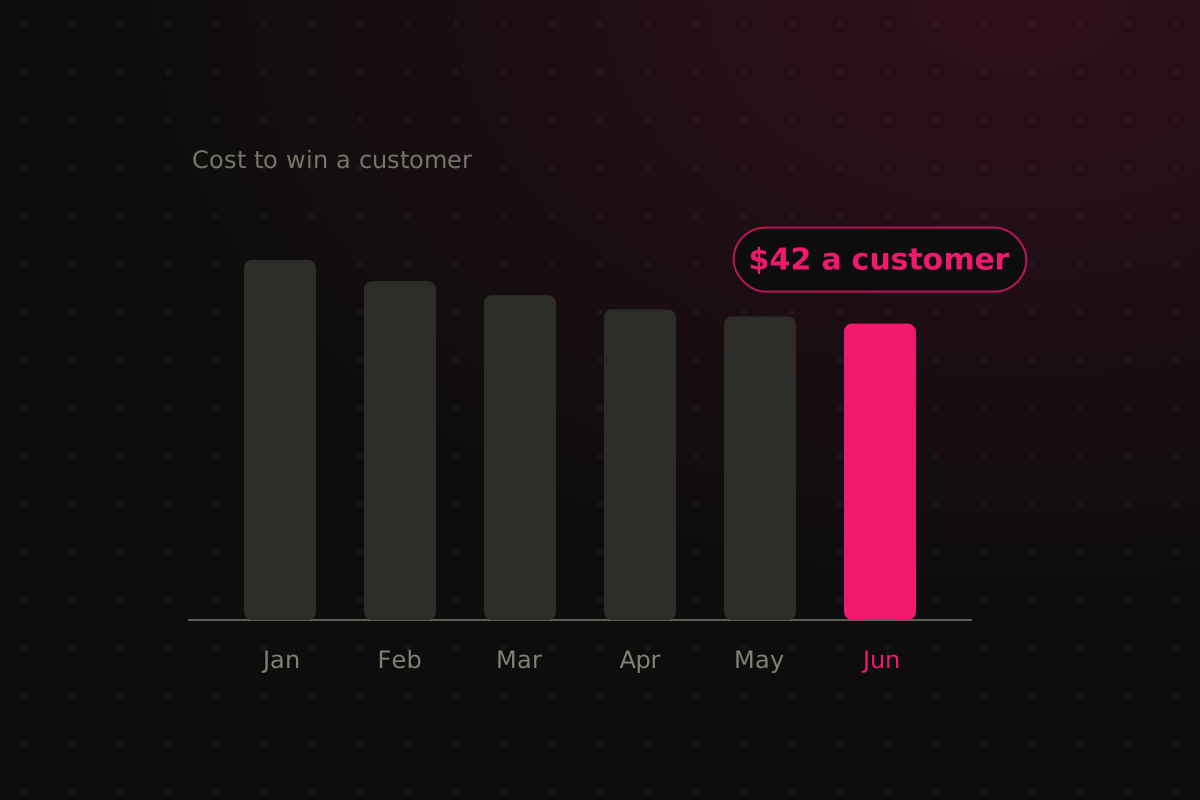
What is a good customer acquisition cost?
A good CAC is below the gross profit a customer brings you, and the further below, the more room you have to grow. Divide lifetime gross profit by CAC to get your LTV to CAC ratio: above 1, customers pay back; below 1, every new one loses money. For how high that ratio should be, read what is a good LTV to CAC ratio, or check yours with the LTV to CAC calculator.
Published "average CAC" figures for online stores disagree too much to use. Benchmark posts put the typical store anywhere from about $20 to well over $100, mostly without saying how the number was measured or which spend it counts. CAC depends on your price, margin and channel mix, so a $90 CAC is cheap for a store with $300 orders and fatal for one with $30 orders. Compare your CAC with your own customer value and your own past quarters.
Do it with Replo
Get blended CAC every week
Replo adds up spend across your ad accounts, divides by new customers and sends CAC every week.
Prompt: “send me blended CAC every Monday”
How long does CAC take to pay back?
CAC payback is how many orders, or months, it takes a new customer to earn back what they cost: CAC payback in orders = CAC ÷ (average order value × gross margin).
If the store above has a $55 average order and a 55% margin, each order leaves $30.25 in gross profit. $46.88 ÷ $30.25 = 1.6 orders, so a customer pays back partway through their second order. If customers buy 2.5 times a year, that second order comes about five months after the first.
A store that pays back on the first order can grow as fast as it can find buyers. One that pays back in year two has to fund every new customer for a year first.
How much is a lower CAC worth?
Keep the same $15,000. If better pages turn more of the same visitors into buyers and you win 375 customers instead of 320, CAC falls to $40. At $140 of lifetime gross profit each, the quarter's customers go from about $29,800 to $37,500 in profit after acquisition cost, with no extra spend.
How to lower your customer acquisition cost
- Convert more of the visitors you pay for. Most of CAC is ad spend that reaches people who don't buy. Find where they stop with heatmaps, then A/B test the headline, offer or layout. Start with the conversion rate calculator.
- Match each ad to its page. Send each campaign to a page with the same product, offer and imagery. Read how landing pages affect ad conversion rate.
- Cut channels that cost more than a customer is worth. Work out paid CAC by channel and compare each with lifetime value. Replo's analytics shows orders and revenue by traffic source and page.
- Raise first-order value. A higher first order pays back more of CAC at once. Bundles and free-shipping thresholds help; see the average order value calculator.
- Watch first-order discounts. A 20% welcome discount counts toward CAC. Test whether a smaller one, or free shipping, wins as many customers.
Questions about customer acquisition cost
- How do you calculate customer acquisition cost?
- Divide what you spent on sales and marketing by the new customers you won in the same period: CAC = marketing spend ÷ new customers. $15,000 that won 320 first-time buyers is a $46.88 CAC.
- What's the difference between CAC and CPA?
- CAC counts all sales and marketing spend per new customer. CPA usually counts ad spend per conversion, and a conversion can be a repeat order or a signup. CAC is stricter, and it's the one to use for deciding whether growth pays.
- What is blended CAC?
- Blended CAC divides all marketing spend by all new customers, including those who came through search, word of mouth or social posts. It's lower than paid CAC and shows what the whole program costs per customer. Track both, because blended can hide an expensive ad channel.
- Should discounts count toward CAC?
- Yes, if they're given to win a first order. A 20% welcome code on a $55 order costs $11 per new customer, the same as $11 of ad spend. Leave out discounts that go to existing customers; those belong in retention costs.
- Why does my CAC keep rising?
- The first customers are the cheapest, because the people most ready to buy find you first. As you spend more, you reach colder audiences. Better pages and offers help, because they raise the share of those colder visitors who buy.
- What's a good LTV to CAC ratio?
- Above 1 means customers pay back; most stores aim well above that so there's room for overhead and profit. The right target depends on your margins and how fast customers reorder. Read what is a good LTV to CAC ratio for the full answer.


