Report
How far shoppers scroll, and what sits above the fold
We measured how far shoppers scroll on 95 online stores' live pages: where the first screen ends, who scrolls past it, and where they tap.
The short answer
On the typical store, 47% of phone visitors get past the first fifth of a page, 28% reach halfway and 9% reach the end. 39% never scroll at all. The first screen on a phone ends about 724 px down, so the price and the buy button belong there.
- of phone visitors pass the first fifth
- 47%
- of phone visitors never scroll
- 39%
- reach the end of the page
- 9%
- where a phone's first screen ends
- 724 px
Half of phone visitors leave before a fifth of the page
A phone page runs about 13.7 screens on the typical store. 47% of visitors pass the first fifth, and 9% reach the end.
- Passed 10% of the page71%
- Passed 20% of the page47%
- Passed 30% of the page39%
- Passed 40% of the page34%
- Passed 50% of the page28%
- Passed 60% of the page24%
- Passed 70% of the page21%
- Passed 80% of the page17%
- Passed 90% of the page12%
- Reached the end9%
Base: over 1,000,000 phone visits to pages taller than one screen on 95 stores. Each store's share, then the median store.
| Point on the page | Phone, typical store | Phone, middle half of stores | Desktop, typical store |
|---|---|---|---|
| 10% | 71% | 49% to 89% | 96% |
| 20% | 47% | 31% to 59% | 75% |
| 30% | 39% | 21% to 51% | 46% |
| 40% | 34% | 16% to 44% | 35% |
| 50% | 28% | 13% to 40% | 28% |
| 60% | 24% | 10% to 36% | 26% |
| 70% | 21% | 8% to 31% | 22% |
| 80% | 17% | 6% to 27% | 20% |
| 90% | 12% | 5% to 23% | 16% |
| The end | 9% | 3% to 16% | 14% |
Most phone screens end 640 to 800 px down
68% of phone visits had a first screen that ended in that band. The typical store's visitors saw 724 px before scrolling.
- Under 560 px6.3%
- 560 to 599 px3.3%
- 600 to 639 px4.5%
- 640 to 679 px17.3%
- 680 to 719 px17.2%
- 720 to 759 px16.4%
- 760 to 799 px16.6%
- 800 to 839 px8.0%
- 840 to 879 px6.8%
- 880 px or more3.5%
Base: over 1,000,000 phone visits on 95 stores. Height is the browser's visible area, after its own bars. Every band holds visits from over 90 stores.
Three in four phone taps happen below the fold
On the typical store, 26% of phone taps land on the first screen. On desktop, 39% of clicks do.
- Phone: first screen26%
- Phone: second screen11%
- Desktop: first screen39%
- Desktop: second screen11%
Base: over 900,000 phone taps on 93 stores and 87,192 desktop clicks on 48 stores. A tap counts as above the fold when it lands within the visitor's first screen.
Taps are spread down the page because the people who scroll keep tapping: galleries, sizes, reviews. The first screen still decides who stays. See how to read a click map.
A product page, measured against the fold
A Replo starter store product page on a phone. The photo fills the first screen, so the price and button start below it.
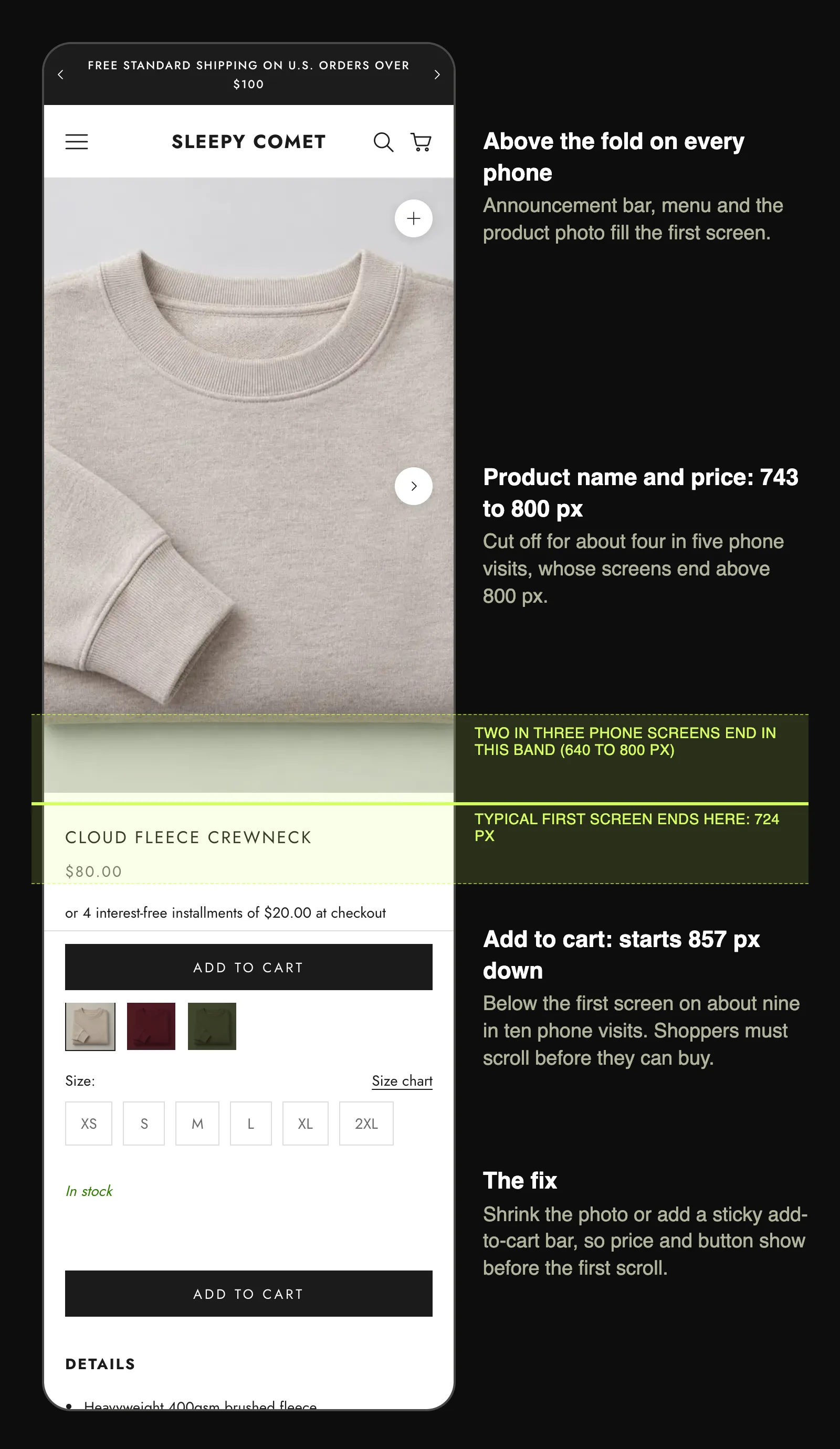
The price ends 800 px down, past the first screen for 82% of phone visits. The button starts 857 px down, below it for about 90%.
What this means for your page
The first screen is the only part nearly every visitor sees. Use it for what makes the sale.
Put price and button first
About 39% of phone visitors never see past the first screen.
Design for 640 px
Two in three phone screens end between 640 and 800 px, so check the short end.
Move one review up
Only 28% reach halfway, where most reviews sit. Put a rating near the price.
Repeat the button at the end
The few who read to the bottom are deciding. Give them a button there.
Step-by-step fixes are in what to change on a product page and how to use a scroll map.
See your own scroll map
Every page Replo publishes shows where each device stops and what each tap led to.


How we counted
- Live pages on online stores that Replo publishes, over 20 days.
- A visit is one visitor on one page. Its depth is the lowest point of the screen they reached.
- Phones are screens under 768 px wide; desktops are 1,024 px or wider.
- A store counts on a device with 200 or more visits to pages taller than one screen.
- Figures are the median store, so one big store can't move them. Every figure rests on 20+ stores.
- Page type isn't shown: fewer than 20 stores had enough product page or homepage visits.
Cite this study
Replo, "How far shoppers scroll, and what sits above the fold," replo.app/reports/scroll-depth
Link to this page when you quote a number.
More studies: where brands send their ad traffic and how long brands keep Meta ads running. New to heatmaps? Start with how to read a heatmap.