CBM calculator for shipping
CBM, cubic meters, is how forwarders measure a shipment's size and price ocean freight. Size one carton by dragging it, set how many ship, and watch them stack into 20 ft, 40 ft and 40 ft high cube containers. Or paste a whole packing list.
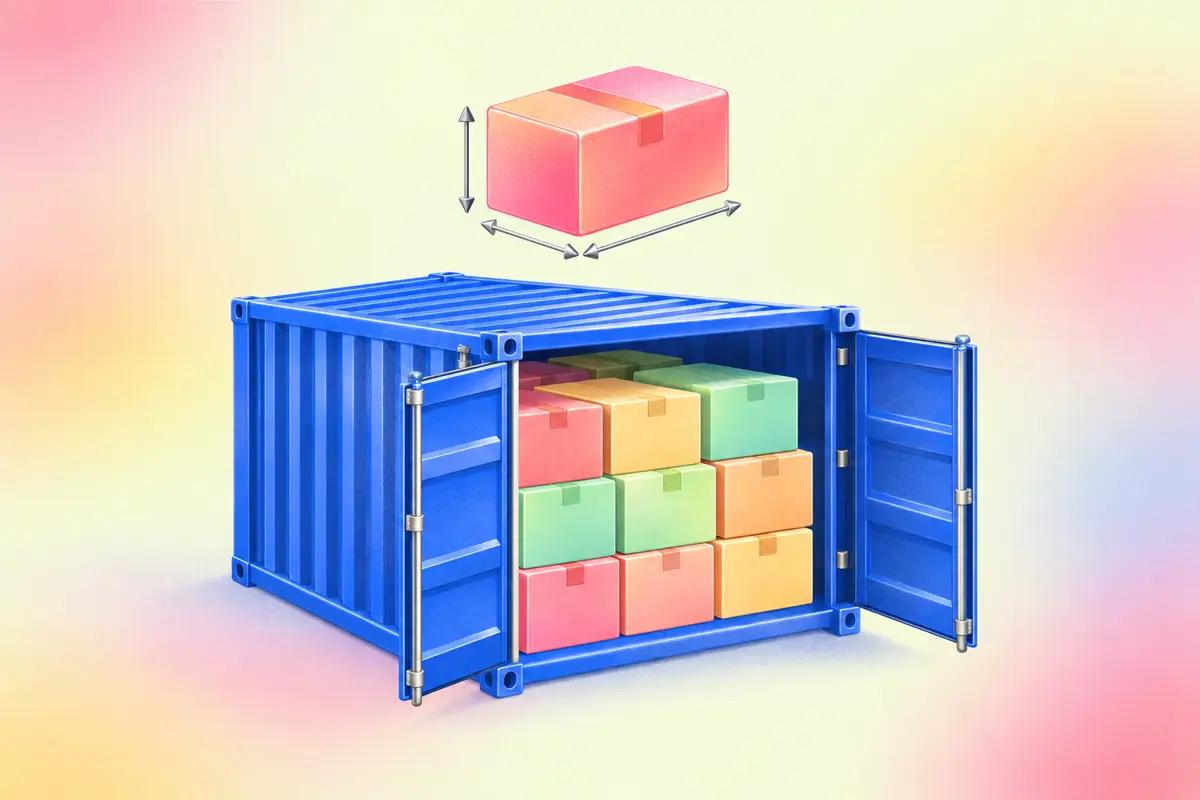
CBM, cubic meters, is how freight forwarders measure a shipment's size: each carton's length × width × height in meters, times the number of cartons. It sets your ocean freight price and how much of a container you fill.
Drag the corners to size one carton.
Total volume (CBM)CBM means cubic meters: a carton's length × width × height in meters. A 60 × 40 × 40 cm carton is 0.096 CBM; a 20 ft container holds about 33.
11.52 m³
120 cartons of 0.0960 m³ take up 11.52 cubic meters (407 ft³). That's a less-than-container (LCL) load: it shares a container and is billed by the cubic meter.
- Gross weightEvery carton's weight added up.
- 1,800 kg
- Ocean LCL bills asLCL, less than container load, means your cartons share a container with other shippers' goods. It bills per revenue ton (W/M): cubic meters or metric tons, whichever is more.
- 11.52 revenue tons (W/M)
- Air freight bills asAir freight bills the larger of the actual weight and the chargeable (volumetric) weight: 167 kg for every cubic meter.
- 1,920 kg chargeable
- Per cartonThe volume of one carton in cubic meters.
- 0.0960 m³
How it fills a container
Each container seen from the side, its door on the right. Green stacks are your cartons; the empty part is space you’d pay for with a full container.
Cartons stacked upright and turned on the floor if more fit, using the container’s inside size. Real loads lose some space to pallets, bracing and odd gaps, so book with room to spare.
Automate your busywork for free. Describe a job once and Replo runs it every week on your real store data.
Have a packing list? Add up every line
Paste your supplier's packing list, one carton size per line as sku, length, width, height, cartons, weight per carton (cm and kg). It runs in your browser; nothing is uploaded.
How to read your number
CBM (cubic meters) is the space a shipment takes up, length × width × height in meters, and it's how ocean and air freight are priced. A 60 × 40 × 40 cm carton is 0.096 m³, so 120 of them are 11.52 m³ (407 cubic feet). That's about a third of a 20 ft container, a typical less-than-container (LCL) load. At 15 kg a carton the shipment weighs 1,800 kg, so LCL bills it as 11.52 revenue tons and air as 1,920 kg.
Why it matters
Ocean and air freight are priced on space as much as weight. Knowing your CBM tells you whether to book LCL or a full container, and how much a smaller carton saves: trimming that carton to 60 × 40 × 35 cm drops the shipment to 10.08 m³, 12.5% less to pay for on every LCL quote.
Automations
Check your CBM on a schedule
Describe the job once. Replo runs it on your data from Shopify, Google Drive and Slack and posts what needs your attention.



Formula
CBM = length (m) × width (m) × height (m) × number of cartons
From centimeters, divide each side by 100 first, or multiply them and divide by 1,000,000. From inches, multiply the three sides and divide by 61,024. One cubic meter is 35.31 cubic feet.
Other ways to calculate CBM
- From centimeters
- CBM = L × W × H (cm) ÷ 1,000,000
- Carton sizes from a supplier in Asia or Europe, almost always in cm.
- From inches
- CBM = L × W × H (in) ÷ 61,024
- US packaging specs. Or get cubic feet with L × W × H ÷ 1,728, then divide by 35.31.
- LCL revenue ton (W/M)
- Chargeable = max(CBM, weight in metric tons)
- Ocean less-than-container freight: 1 CBM is treated as 1,000 kg, and you pay for whichever is larger.
- Air chargeable weight
- Chargeable kg = max(actual kg, CBM × 166.67)
- Air cargo: the standard 6,000 cm³ per kg factor. A cubic meter bills as at least 167 kg.
What is CBM in shipping?
CBM stands for cubic meter, the volume of a box 1 meter on each side. Freight forwarders quote ocean and air freight by CBM because a ship or plane runs out of space before it runs out of weight capacity for most consumer goods.
You'll see it on supplier packing lists ("120 ctns, 11.52 CBM") and on LCL quotes ("$85 per CBM"). Check it before you book: the packing list's number decides what the forwarder bills.
How to calculate CBM
- Measure one carton at its widest points, bulges included: 60 × 40 × 40 cm.
- Convert to meters: 0.6 × 0.4 × 0.4.
- Multiply: 0.096 m³ per carton.
- Multiply by the cartons: 0.096 × 120 = 11.52 CBM.
- For mixed cartons, work out each size and add them up, or paste the packing list into the calculator above.
How many cartons fit in a container?
Divide each inside dimension of the container by the carton's matching side, round each down, and multiply. A 20 ft container is about 5.90 × 2.35 × 2.39 m inside, so 60 × 40 × 40 cm cartons fit 9 along, 5 across and 5 high: 225 cartons, upright. Turning them on the floor gives 14 × 3 × 5 = 210, so the first way wins.
The same cartons fit 500 in a 40 ft and 600 in a 40 ft high cube, whose extra 30 cm of height adds a sixth layer. Weight can stop you first: at 50 kg a carton, a 20 ft container's 28,300 kg payload caps it at 566.
How to calculate CBM: a worked example
A home goods brand ships 120 cartons of 60 × 40 × 40 cm, 15 kg each, from Ningbo to Los Angeles.
- Per carton = 0.6 × 0.4 × 0.4 = 0.096 m³
- Total = 0.096 × 120 = 11.52 m³ (406.8 ft³)
- Weight = 120 × 15 = 1,800 kg = 1.8 t, so LCL bills max(11.52, 1.8) = 11.52 revenue tons
- By air: max(1,800 kg, 11.52 × 166.67 = 1,920 kg) = 1,920 kg chargeable
11.52 CBM fills about 35% of a 20 ft container's 33.2 m³, so it ships LCL. Around 25 m³ a full 20 ft container often becomes the cheaper quote.
LCL or a full container?
LCL is priced per CBM, a full container (FCL) per box. Divide the container's price by your LCL rate per CBM to find the break-even volume: at $85 per CBM and $2,100 for a 20 ft container, it's about 25 m³. Below that, LCL is cheaper; above it, book the container even if it's not full.
Plan on loading about 85% of a container's internal volume, since cartons rarely fill every gap. That's about 28 m³ in a 20 ft, 58 m³ in a 40 ft and 65 m³ in a 40 ft high cube.
| Container | Internal volume | Practical load (85%) | Max payload |
|---|---|---|---|
| 20 ft standard | 33.2 m³ (1,172 ft³) | about 28 m³ | 28,300 kg |
| 40 ft standard | 67.7 m³ (2,391 ft³) | about 58 m³ | 28,870 kg |
| 40 ft high cube | 76.4 m³ (2,698 ft³) | about 65 m³ | 28,690 kg |
Questions about CBM
- What does CBM mean in shipping?
- CBM stands for cubic meter, the unit forwarders use for a shipment's volume: length × width × height in meters. A 60 × 40 × 40 cm carton is 0.096 CBM, and 120 of them are 11.52 CBM. It sets the price of shared-container (LCL) freight and how much of a container you fill.
- How do you calculate CBM from cm?
- Multiply length, width and height in centimeters and divide by 1,000,000. A 60 × 40 × 40 cm carton is 96,000 ÷ 1,000,000 = 0.096 CBM. Multiply by the number of cartons for the shipment.
- How many cubic feet are in 1 CBM?
- One cubic meter is 35.31 cubic feet. To convert cubic feet to CBM, divide by 35.31; 407 cubic feet is 11.5 CBM.
- How many CBM fit in a 20 ft container?
- A 20 ft standard container holds 33.2 m³ inside, and about 28 m³ of cartons in practice. A 40 ft holds 67.7 m³ (about 58 loadable) and a 40 ft high cube 76.4 m³ (about 65).
- What is LCL shipping?
- LCL means less than container load: your cartons share a container with other shippers' goods, and you pay for your share by volume. It's usually cheaper than a full container under about 15 CBM. FCL, full container load, is a container to yourself at a flat price.
- What does W/M mean on a freight quote?
- Weight or measure: LCL ocean freight bills the larger of the volume in cubic meters and the weight in metric tons. 11.52 CBM weighing 1.8 tons bills as 11.52; 2 CBM of tiles weighing 3 tons bills as 3.
Sources
Do it with Replo
Track shipping cost per order
Replo reports what shipping costs you as a share of each order, so a cheaper carton or route shows up in your numbers.
Prompt: “show shipping cost as a share of order value each week”