Discount break-even calculator
A discount comes straight out of your profit on each sale, so you have to sell more just to earn what you earn today. Enter your margin and the discount, or drag along the curve, to see how many more sales it needs. Or paste your catalog to see which products a sitewide sale can carry.
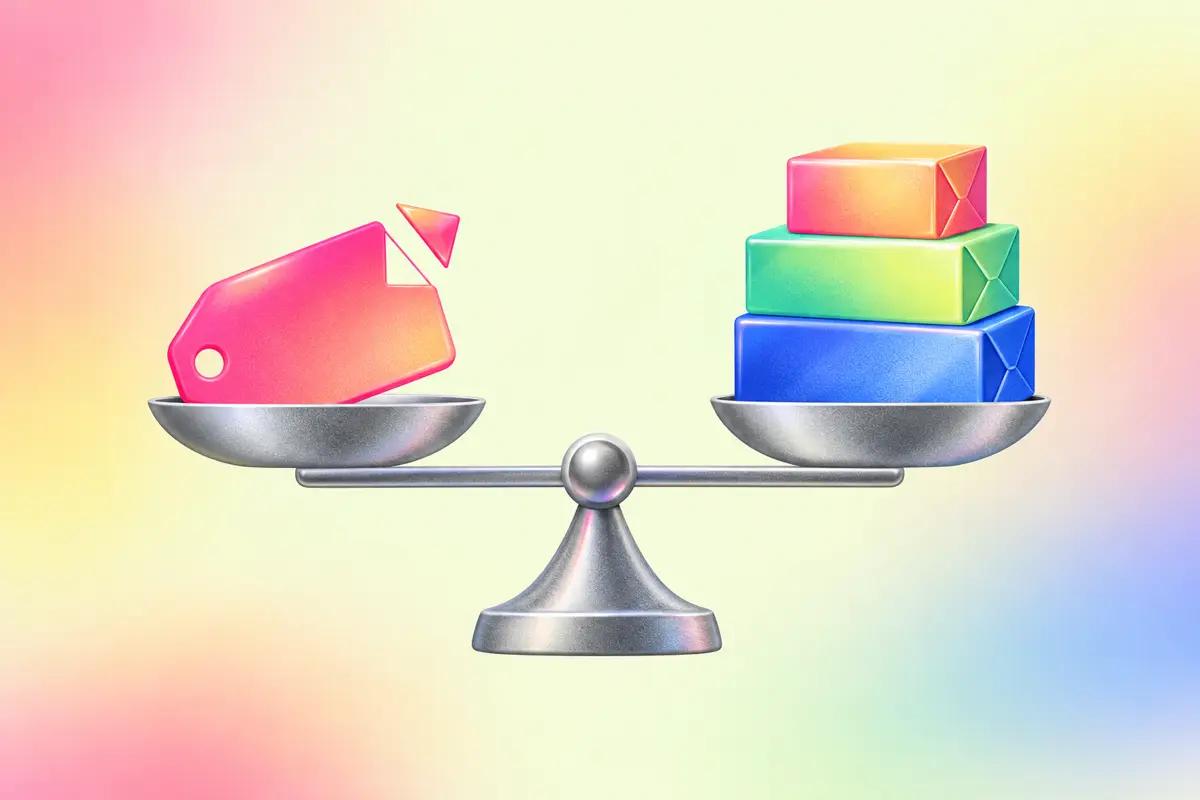
A discount comes straight out of your profit per sale, so you have to sell more just to stay even. See how many more sales a discount needs, and whether the lift you expect pays for it.
- Extra sales the discount needsDiscount ÷ (margin − discount): the extra units that bring gross profit back to what you earn at full price.
+50%
20% off a 60% margin- Units to break even
- 750instead of 500 a month
- Profit per unit
- $20.00instead of $30.00
- At a +30% lift
- −$2,000gross profit a month vs $15,000 at full price
Showing the worked example: a $50 product at a 60% margin, 500 units a month. Drag the chart or type your own.
Get a daily report card for free. Replo has a daily report card of your business ready every morning, with what changed and why.
How to read your number
Discount break-even is the extra sales volume, as a share of what you sell now, that a discount needs to keep gross profit where it was. At a 60% margin, 20% off needs 50% more sales: 500 units a month at full price becomes 750 on sale. If the sale lifts volume by less than that, it costs you profit even when revenue goes up.
Why it matters
A discount comes straight out of margin, so it shrinks every sale's profit by much more than the headline percentage. 20% off a 60% margin product takes a third of its profit per unit. Knowing the lift you need before a sale tells you whether the offer can pay, how deep to go, and which products can carry it.
Formula
Required sales lift = discount ÷ (gross margin − discount)
Use both as shares of the full price: a 20% discount at a 60% margin is 0.20 ÷ (0.60 − 0.20) = 0.5, so you need 50% more units. When the discount reaches your margin, the bottom of the fraction hits zero: each sale earns nothing and no volume makes up for it.
Other ways to calculate discount break-even
- Units needed
- Units on sale = units today × margin ÷ (margin − discount)
- When you plan a promotion by units or stock. 500 units × 0.60 ÷ 0.40 = 750 units.
- In dollars per unit
- Required lift = discount $ ÷ (gross profit per unit − discount $)
- When the offer is a fixed amount off, such as $10 off a $50 item with $30 of profit: $10 ÷ $20 = 50%.
- With fixed promotion costs
- Units needed = (gross profit today + promotion costs) ÷ profit per unit on sale
- When the sale also costs money up front, such as ads, creative or a launch email, so it has to cover those as well.
- Price increase: sales you can lose
- Allowed drop in sales = increase ÷ (margin + increase)
- The same math run the other way. At a 60% margin, a 10% price rise still earns the same profit if you lose up to 0.10 ÷ 0.70 = 14.3% of units.
Why discounts need so much extra volume
A discount is taken from the price, but it comes entirely out of your profit. On a $50 product that costs $20 to make, you earn $30. Take 20% off and the price falls $10, the cost stays $20, and you now earn $20. You lost a third of the profit per unit, so you need 50% more units to earn the same total.
That's why the required lift climbs faster than the discount: it divides by what's left of the margin, and that shrinks as the discount grows. The same logic is why small price increases tend to move profit far more than small cost cuts, a pattern McKinsey's pricing work made well known (source).
How to calculate discount break-even: a worked example
A store sells 500 units a month of a $50 product with a 60% gross margin, so each unit costs $20 and earns $30. It's planning a 20% off sale.
- Required lift = 0.20 ÷ (0.60 − 0.20) = 0.50, or 50%
- Units needed = 500 × 1.5 = 750 units
- Today: 500 × $30 = $15,000 of gross profit
- On sale: the price is $40 and each unit earns $20, so 750 × $20 = $15,000
The sale has to sell 750 units, 250 more than usual, just to stay level. At 650 units it brings in more revenue but $2,000 less gross profit.
How deep should a discount go?
Keep the discount well under half your margin. At half your margin, the required lift is exactly 100%: a 30% discount on a 60% margin product has to double sales to break even. Few promotions do that for long, so deeper cuts usually only make sense to clear stock you'd otherwise write off.
Two things help a discount pay. Point it at shoppers who wouldn't buy at full price, such as new visitors from ads or lapsed customers, rather than your regulars. And measure the lift: run the offer as an A/B test against full price, and compare gross profit per visitor, not orders. Check your margin first with the profit margin calculator.
| Discount | 30% margin | 40% margin | 50% margin | 60% margin | 70% margin |
|---|---|---|---|---|---|
| 10% off | +50% | +33% | +25% | +20% | +17% |
| 15% off | +100% | +60% | +43% | +33% | +27% |
| 20% off | +200% | +100% | +67% | +50% | +40% |
| 25% off | +500% | +167% | +100% | +71% | +56% |
| 30% off | Never | +300% | +150% | +100% | +75% |
| 40% off | Never | Never | +400% | +200% | +133% |
Questions about discount break-even
- How much more do I need to sell to offset a discount?
- Divide the discount by your gross margin minus the discount. At a 50% margin, 20% off needs 0.20 ÷ 0.30 = 67% more sales to earn the same gross profit. The lower your margin, the more extra volume each point of discount needs.
- Does a discount ever pay for itself?
- Yes, when the extra sales beat the required lift, or when the discount brings in customers who come back at full price. Count repeat purchases separately: the first order alone rarely covers a deep discount, so check it against customer lifetime value.
- Why does a 20% discount cut profit by more than 20%?
- Because the discount comes out of profit, not out of price and cost together. On a 40% margin product, 20% off removes half of what each sale earns, so profit per unit drops 50% even though the price fell 20%.
- Is it better to discount or offer free shipping?
- Compare the cost of each per order against the same lift formula. Free shipping costs your average shipping charge; a discount costs the percentage times the order. Whichever costs less per order needs the smaller lift, so run that one, or test both.
- How do I check a sitewide sale across every product?
- Work out each product's margin and run the same formula for each one, since a 20% sale needs only 50% more sales on a 60% margin product but 200% more on a 30% margin one. In the calculator, switch to the catalog view and paste or upload a CSV of SKU, price and cost: it lists the extra sales each product needs and flags the ones that lose profit at your expected lift.
- What's the break-even discount for a price increase?
- Run it in reverse: allowed drop in sales = increase ÷ (margin + increase). At a 50% margin, a 10% price rise keeps the same gross profit as long as you lose fewer than 0.10 ÷ 0.60 = 16.7% of units.
Sources
Experiments
A/B test your pages in Replo
Split traffic between two versions of a Replo page and see which one sells, with the result next to your sales.