Bundle pricing calculator
A bundle sells several products together for less than they cost apart. Add the price and cost of each item, then drag the discount to see the bundle price, its margin, and the point where the bundle stops earning more than the main item alone.
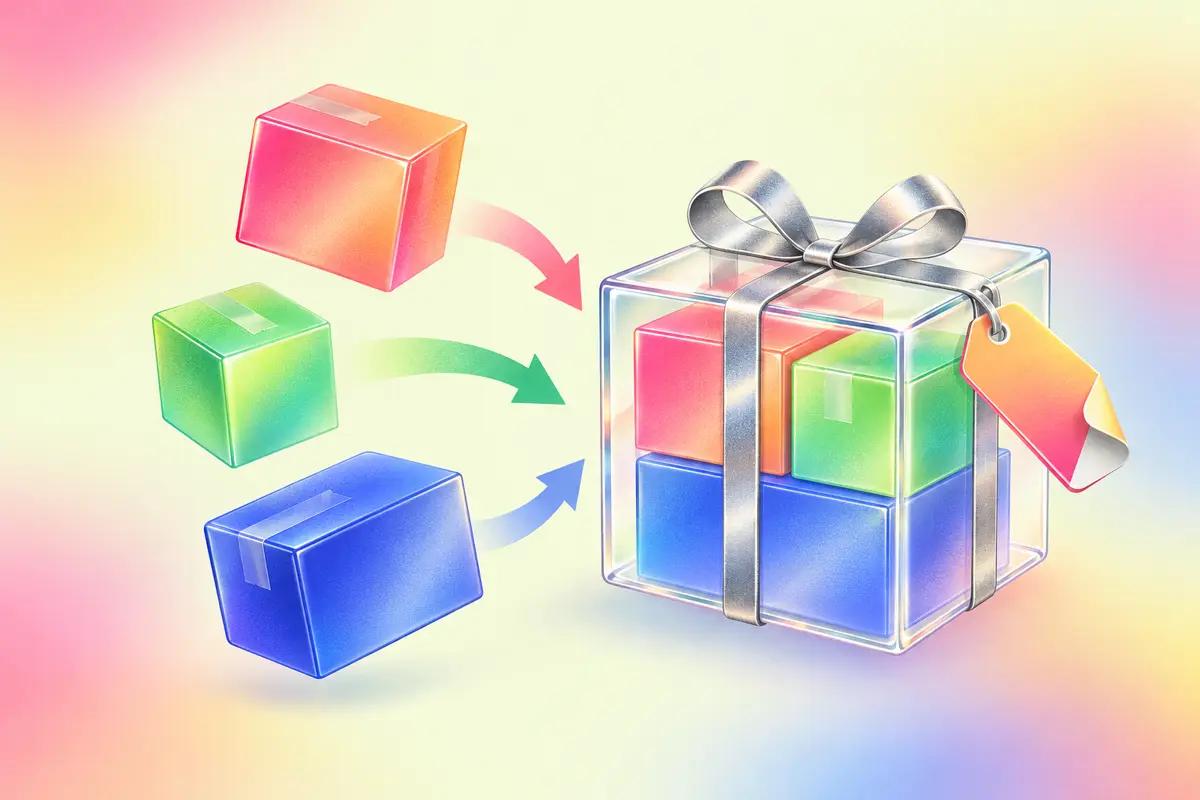
A bundle sells several items together for less than they cost apart. Price yours so the bigger order earns more than the main item would on its own.
- Bundle price
$76.50
customers save $13.50 on $90.00- Bundle marginGross profit as a share of the bundle price: (price − item costs) ÷ price.
- 64.7%vs 70.0% sold separately
- Against the main item alone
- +$21.50more gross profit per order
- Deepest discount that still beats it
- 38.9%60% margin price: $67.50
Showing the worked example: a $40 serum, $30 moisturizer and $20 cleanser at 15% off. Drag the chart or type your own.
Get a daily report card for free. Replo has a daily report card of your business ready every morning, with what changed and why.
How to read your number
Bundle pricing is selling two or more products together for less than their separate prices, and the bundle price is their combined price minus the discount. At $40, $30 and $20 with 15% off, the bundle sells for $76.50, saves the customer $13.50, and earns $49.50 of gross profit at a 64.7% margin. The main item alone earns $28, so each shopper who takes the bundle instead earns you $21.50 more, and any discount up to 38.9% still beats the single sale.
Why it matters
A bundle trades a little margin for a bigger order. Whether that trade pays depends on what the shopper would have bought without it. Compared with the full set at full price, every bundle gives profit away; compared with the one item most people buy, a well-priced bundle earns much more. Pricing it against the main item tells you how much discount you can afford.
Formula
Bundle price = sum of item prices × (1 − discount); bundle margin = (bundle price − sum of item costs) ÷ bundle price
Costs are what each item costs you to buy or make, landed. Add packaging or fulfillment costs that change with the bundle, such as a gift box, to the item costs.
Other ways to calculate bundle pricing
- Deepest discount that beats a single sale
- Max discount = 1 − (bundle cost + main item's profit) ÷ bundle full price
- When most bundle buyers would otherwise buy only the main item. In the example: 1 − ($27 + $28) ÷ $90 = 38.9%.
- Price for a target margin
- Bundle price = bundle cost ÷ (1 − target margin)
- When you want the bundle to keep a set margin, such as 60%: $27 ÷ 0.40 = $67.50, which is 25% off $90.
- Fixed dollar savings
- Bundle price = sum of item prices − savings
- When the offer is "save $15". The margin formula stays the same; a dollar figure often reads better on low-priced sets.
- Buy more, save more
- Price of n units = n × unit price × (1 − tier discount)
- For quantity bundles of the same product, such as 3 for the price of 2.5. Check each tier's margin the same way.
Which items to bundle
- A bestseller with something people add later. Pair the product most shoppers come for with the one they often buy on a second order, such as a cleanser with a moisturizer.
- A high-margin item in every bundle. Accessories and refills carry the discount better than the hero product, so the bundle's margin stays up.
- Slow movers, carefully. Adding a slow seller moves stock, but only if it still reads as a set customers want; check the result against the sell-through rate calculator.
How to calculate bundle pricing: a worked example
A skincare store bundles a $40 serum (cost $12), a $30 moisturizer (cost $9) and a $20 cleanser (cost $6) at 15% off. Most shoppers who come for the serum buy only the serum.
- Bought separately: $40 + $30 + $20 = $90, costing $27
- Bundle price = $90 × (1 − 0.15) = $76.50; the customer saves $13.50
- Gross profit = $76.50 − $27 = $49.50; margin = $49.50 ÷ $76.50 = 64.7%
- Serum alone: $40 − $12 = $28 of gross profit
- Deepest discount that still beats the serum alone = 1 − ($27 + $28) ÷ $90 = 38.9%
The bundle earns $21.50 more than a serum-only order. The margin falls from 70% to 64.7%, but the order brings in nearly twice the gross profit.
What's a good bundle discount?
Enough that the saving is clear, and far enough under the deepest break-even discount that the bundle still earns more than the single item if some shoppers would have bought the full set anyway. In the example, anything from 10% to 25% leaves room on both sides.
Then measure. Run the bundle as an A/B test and compare gross profit per visitor, not conversion rate alone: a bundle that converts slightly less but lifts average order value can still win.
| Discount | Bundle price | Gross profit | Margin | Against the serum alone |
|---|---|---|---|---|
| 0% off | $90.00 | $63.00 | 70.0% | +$35.00 |
| 10% off | $81.00 | $54.00 | 66.7% | +$26.00 |
| 15% off | $76.50 | $49.50 | 64.7% | +$21.50 |
| 20% off | $72.00 | $45.00 | 62.5% | +$17.00 |
| 25% off | $67.50 | $40.50 | 60.0% | +$12.50 |
| 30% off | $63.00 | $36.00 | 57.1% | +$8.00 |
| 40% off | $54.00 | $27.00 | 50.0% | −$1.00 |
Questions about bundle pricing
- What is price bundling?
- Price bundling is selling two or more products together at one price, usually lower than buying them separately. A serum, moisturizer and cleanser sold as a $76.50 set instead of $90 apart is a bundle: shoppers save, and you earn more per order.
- How do you calculate a bundle price?
- Add up the full prices of the items, then take off the discount. Three items at $40, $30 and $20 with 15% off make a $76.50 bundle. Check the margin by subtracting the items' total cost and dividing by the bundle price.
- How much should you discount a bundle?
- Most bundles sit between 10% and 25% off. Work out the deepest discount at which a bundle still earns more than the single item most shoppers buy, then stay well under it so the bundle pays even when some buyers would have bought everything.
- Do bundles increase profit?
- Yes, when they replace smaller orders rather than full-price ones. A bundle earns less per item but more per order, so it raises profit when it lifts average order value by more than the discount gives away.
- What is mixed bundling?
- Selling the items both on their own and as a bundle, so shoppers can choose. It's what most stores do: the single items set the reference price that makes the bundle saving visible.
Sources
Experiments
A/B test your pages in Replo
Split traffic between two versions of a Replo page and see which one sells, with the result next to your sales.