Sales tax nexus calculator: economic nexus by state
Nexus is the link to a state that makes you collect its sales tax, and selling enough into a state creates it: most draw the line at $100,000 a year. Click the states you sell into, or paste your sales by state, and the map lights up the thresholds you've crossed and how close you are to the rest.
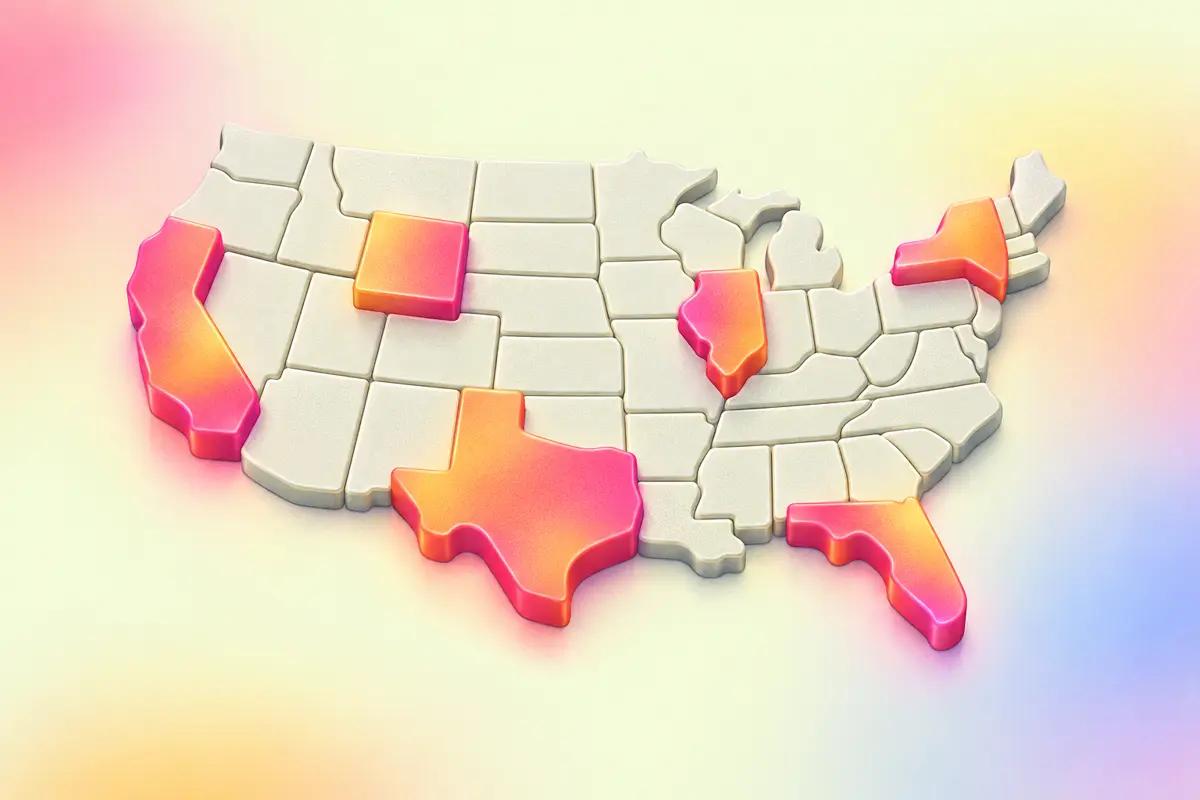
Nexus is the link to a state that makes you collect its sales tax. Selling enough into a state is enough to create it: most states draw the line at $100,000 a year. This is economic nexus, set by the 2018 Supreme Court case South Dakota v. Wayfair. A warehouse, office or staff in a state (physical nexus) creates it too, whatever your sales.
Click the states you sell into, or paste your sales by state. Green means you’ve crossed that state’s threshold, pink that you’re within a quarter of it.
- $100,000 threshold
- $250,000
- $500,000
- No sales tax
Drag to see which states a good year pushes over. The map and the list redraw as you go.
Start with the map
Click a state to add it and type what you sold there over the last 12 months. Or paste a whole sheet below: one row per state, with sales and, if you have them, orders.
Most states use $100,000 of sales. California, New York and Texas use $500,000; Alabama and Mississippi $250,000.
Or paste sales by state
One row per state: the state, your sales into it and, if you have it, the number of orders, over the last 12 months or last calendar year. A sales-by-billing-region report works as it is; monthly rows for the same state add up.Economic nexus thresholds by state
What each state counts, and over which period. Search for a state, or scroll the list.
| State | Threshold | Measured over | What counts |
|---|---|---|---|
| Alabama | $250,000 in sales | Previous calendar year | Retail sales |
| Alaska | $100,000 in salesNo state sales tax; local towns that joined the Alaska Remote Seller Sales Tax Commission use this threshold. | Current or previous calendar year | Gross sales into the state |
| Arizona | $100,000 in sales | Current or previous calendar year | Gross sales |
| Arkansas | $100,000 or 200 transactions | Current or previous calendar year | Taxable sales |
| California | $500,000 in sales | Current or previous calendar year | Sales of tangible goods |
| Colorado | $100,000 in sales | Current or previous calendar year | Retail sales |
| Connecticut | $100,000 and 200 transactions | 12 months ending September 30 | Retail sales |
| Delaware | No statewide sales tax | – | – |
| District of Columbia | $100,000 or 200 transactions | Current or previous calendar year | Retail sales |
| Florida | $100,000 in sales | Previous calendar year | Taxable sales |
| Georgia | $100,000 or 200 transactions | Current or previous calendar year | Retail sales |
| Hawaii | $100,000 or 200 transactionsHawaii's general excise tax is charged to the seller, not added as sales tax. | Current or previous calendar year | Gross sales |
| Idaho | $100,000 in sales | Current or previous calendar year | Gross sales |
| Illinois | $100,000 in salesThe 200-transaction test ended January 1, 2026. | Previous 12 months | Retail sales |
| Indiana | $100,000 in sales | Current or previous calendar year | Gross sales |
| Iowa | $100,000 in sales | Current or previous calendar year | Gross sales |
| Kansas | $100,000 in sales | Current or previous calendar year | Gross sales |
| Kentucky | $100,000 in salesThe 200-transaction test ended August 1, 2026. | Current or previous calendar year | Gross sales |
| Louisiana | $100,000 in sales | Current or previous calendar year | Gross sales |
| Maine | $100,000 in sales | Current or previous calendar year | Gross sales |
| Maryland | $100,000 or 200 transactions | Current or previous calendar year | Gross sales |
| Massachusetts | $100,000 in sales | Current or previous calendar year | Gross sales |
| Michigan | $100,000 or 200 transactions | Previous calendar year | Gross sales |
| Minnesota | $100,000 or 200 transactions | 12 months ending with the last full quarter | Retail sales |
| Mississippi | More than $250,000 in sales | Previous 12 months | Gross sales |
| Missouri | $100,000 in sales | Previous 12 months, checked each quarter | Taxable sales |
| Montana | No statewide sales tax | – | – |
| Nebraska | $100,000 or 200 transactions | Current or previous calendar year | Retail sales |
| Nevada | $100,000 or 200 transactions | Current or previous calendar year | Retail sales |
| New Hampshire | No statewide sales tax | – | – |
| New Jersey | $100,000 or 200 transactions | Current or previous calendar year | Gross sales |
| New Mexico | $100,000 in sales | Previous calendar year | Taxable sales |
| New York | More than $500,000 and more than 100 transactions | Previous four sales tax quarters | Sales of tangible goods |
| North Carolina | $100,000 in sales | Current or previous calendar year | Gross sales |
| North Dakota | $100,000 in sales | Current or previous calendar year | Taxable sales |
| Ohio | $100,000 or 200 transactions | Current or previous calendar year | Retail sales |
| Oklahoma | $100,000 in sales | Current or previous calendar year | Taxable sales of goods |
| Oregon | No statewide sales tax | – | – |
| Pennsylvania | $100,000 in sales | Previous 12 months | Gross sales |
| Rhode Island | $100,000 or 200 transactions | Previous calendar year | Gross sales |
| South Carolina | $100,000 in sales | Current or previous calendar year | Gross sales |
| South Dakota | $100,000 in sales | Current or previous calendar year | Gross sales |
| Tennessee | $100,000 in sales | Previous 12 months | Retail sales |
| Texas | $500,000 in sales | Previous 12 months | Gross revenue |
| Utah | $100,000 in sales | Current or previous calendar year | Gross sales |
| Vermont | $100,000 or 200 transactions | Previous four calendar quarters | Gross sales |
| Virginia | $100,000 or 200 transactions | Current or previous calendar year | Retail sales |
| Washington | $100,000 in sales | Current or previous calendar year | Gross receipts |
| West Virginia | $100,000 or 200 transactions | Current or previous calendar year | Gross sales |
| Wisconsin | $100,000 in sales | Current or previous calendar year | Gross sales |
| Wyoming | $100,000 in sales | Current or previous calendar year | Gross sales |
How to read your number
Economic nexus is the amount of sales into a state that obliges a remote seller to register and collect that state's sales tax, even with no office or stock there. A store that sold $120,000 into Arkansas, $610,000 into Texas and $80,000 into New York has nexus in two of the three. Arkansas counts $100,000 or 200 transactions; Texas only counts sales past $500,000. New York needs both more than $500,000 and more than 100 transactions, so $80,000 is 16% of the way.
Why it matters
Once you cross a state's threshold you have to register, collect its sales tax on orders shipped there, and file returns. Miss it and the state can bill you for the tax you didn't collect, plus interest and penalties, out of your own margin. Checking each quarter tells you where to register before that happens.
Automations
Check your sales tax nexus on a schedule
Describe the job once. Replo runs it on your data from Shopify, Google Drive and Slack and posts what needs your attention.



Formula
Nexus = sales into the state ≥ the state's sales threshold, OR (in some states) transactions ≥ its transaction threshold, over the state's measurement period
Most states use $100,000 of sales in the current or previous calendar year. California, New York and Texas use $500,000; Alabama and Mississippi use $250,000. Connecticut and New York require both a sales and a transaction test. Five states have no statewide sales tax.
Other ways to calculate sales tax nexus
- Sales only
- nexus = sales ≥ threshold
- Most states now, including California, Texas, Florida, Illinois and Kentucky, which have dropped their transaction tests.
- Sales or transactions
- nexus = sales ≥ $100,000 OR transactions ≥ 200
- States that still count orders, such as Georgia, Michigan, New Jersey, Ohio and Virginia. Many small orders can trigger nexus before the dollar test does.
- Sales and transactions
- nexus = sales ≥ threshold AND transactions ≥ count
- Connecticut ($100,000 and 200) and New York (more than $500,000 and more than 100). Both tests have to be met.
- Gross vs. retail vs. taxable sales
- sales counted = gross, or minus resale, or minus exempt sales
- Read the state's 'what counts' column. A store selling mostly exempt goods (clothing in some states, groceries) may cross a gross-sales test but not a taxable-sales one.
What is sales tax nexus?
Sales tax nexus is the connection with a state that obliges a seller to collect that state's sales tax. Having an office, staff or inventory there creates physical nexus. Since the Supreme Court's 2018 South Dakota v. Wayfair decision, selling enough into a state creates economic nexus too, even with nothing physically there.
Every state with a sales tax now has an economic nexus threshold for remote sellers. The threshold is a dollar amount of sales, sometimes with a count of transactions, measured over a set period.
How to check whether you have nexus
- Export sales by ship-to state. A sales-by-region report pastes straight into the calculator above. Use the measurement period each state uses: most look at the current or previous calendar year; Texas, Tennessee and Pennsylvania look at the previous 12 months.
- Use the sales the state counts. Most count gross sales, some only retail or taxable sales. Several include sales made through marketplaces like Amazon in the total.
- Count transactions where it matters. Only states that still have a transaction test need the order count.
- Compare each state to its threshold. Once you cross one, register before you collect, then collect from the date the state sets.
How to calculate sales tax nexus: a worked example
A store sold $120,000 in 900 orders into Arkansas, $610,000 in 4,100 orders into Texas and $80,000 in 240 orders into New York over the last 12 months.
- Arkansas: $100,000 or 200 transactions. $120,000 ≥ $100,000, so nexus
- Texas: $500,000 in sales. $610,000 ≥ $500,000, so nexus
- New York: more than $500,000 and more than 100 transactions. 240 orders pass, but $80,000 is only 16% of the sales test, so no nexus
The store registers in Arkansas and Texas and collects there; New York stays on the watch list.
What to do once you cross a threshold
Register before you collect. Collecting sales tax without a permit isn't allowed. Most states give you a short window, often the first day of the next month or quarter, after you cross.
Turn on collection for that state only. Shopify and most platforms collect per state once you add the registration. Keep the rates current; local rates change several times a year.
If you crossed a while ago, many states offer a voluntary disclosure agreement that limits back tax and waives penalties. This page is an estimate, not tax advice; a sales tax professional can tell you what you owe.
| State | Threshold | Measured over |
|---|---|---|
| Alabama | $250,000 in sales | Previous calendar year |
| Alaska | $100,000 in sales | Current or previous calendar year |
| Arizona | $100,000 in sales | Current or previous calendar year |
| Arkansas | $100,000 or 200 transactions | Current or previous calendar year |
| California | $500,000 in sales | Current or previous calendar year |
| Colorado | $100,000 in sales | Current or previous calendar year |
| Connecticut | $100,000 and 200 transactions | 12 months ending September 30 |
| Delaware | No statewide sales tax | – |
| District of Columbia | $100,000 or 200 transactions | Current or previous calendar year |
| Florida | $100,000 in sales | Previous calendar year |
| Georgia | $100,000 or 200 transactions | Current or previous calendar year |
| Hawaii | $100,000 or 200 transactions | Current or previous calendar year |
| Idaho | $100,000 in sales | Current or previous calendar year |
| Illinois | $100,000 in sales | Previous 12 months |
| Indiana | $100,000 in sales | Current or previous calendar year |
| Iowa | $100,000 in sales | Current or previous calendar year |
| Kansas | $100,000 in sales | Current or previous calendar year |
| Kentucky | $100,000 in sales | Current or previous calendar year |
| Louisiana | $100,000 in sales | Current or previous calendar year |
| Maine | $100,000 in sales | Current or previous calendar year |
| Maryland | $100,000 or 200 transactions | Current or previous calendar year |
| Massachusetts | $100,000 in sales | Current or previous calendar year |
| Michigan | $100,000 or 200 transactions | Previous calendar year |
| Minnesota | $100,000 or 200 transactions | 12 months ending with the last full quarter |
| Mississippi | More than $250,000 in sales | Previous 12 months |
| Missouri | $100,000 in sales | Previous 12 months, checked each quarter |
| Montana | No statewide sales tax | – |
| Nebraska | $100,000 or 200 transactions | Current or previous calendar year |
| Nevada | $100,000 or 200 transactions | Current or previous calendar year |
| New Hampshire | No statewide sales tax | – |
| New Jersey | $100,000 or 200 transactions | Current or previous calendar year |
| New Mexico | $100,000 in sales | Previous calendar year |
| New York | More than $500,000 and more than 100 transactions | Previous four sales tax quarters |
| North Carolina | $100,000 in sales | Current or previous calendar year |
| North Dakota | $100,000 in sales | Current or previous calendar year |
| Ohio | $100,000 or 200 transactions | Current or previous calendar year |
| Oklahoma | $100,000 in sales | Current or previous calendar year |
| Oregon | No statewide sales tax | – |
| Pennsylvania | $100,000 in sales | Previous 12 months |
| Rhode Island | $100,000 or 200 transactions | Previous calendar year |
| South Carolina | $100,000 in sales | Current or previous calendar year |
| South Dakota | $100,000 in sales | Current or previous calendar year |
| Tennessee | $100,000 in sales | Previous 12 months |
| Texas | $500,000 in sales | Previous 12 months |
| Utah | $100,000 in sales | Current or previous calendar year |
| Vermont | $100,000 or 200 transactions | Previous four calendar quarters |
| Virginia | $100,000 or 200 transactions | Current or previous calendar year |
| Washington | $100,000 in sales | Current or previous calendar year |
| West Virginia | $100,000 or 200 transactions | Current or previous calendar year |
| Wisconsin | $100,000 in sales | Current or previous calendar year |
| Wyoming | $100,000 in sales | Current or previous calendar year |
Questions about sales tax nexus
- What is sales tax nexus?
- Sales tax nexus is a connection to a state that obliges a seller to register, collect that state's sales tax and file returns. Physical nexus comes from an office, staff or stock in the state; economic nexus comes from selling past the state's threshold, usually $100,000 a year, with nothing there at all.
- What is the economic nexus threshold in most states?
- Most states use $100,000 in sales into the state over the current or previous calendar year. California, New York and Texas use $500,000, and Alabama and Mississippi use $250,000. A shrinking group also counts 200 transactions as a separate trigger.
- Do marketplace sales count toward nexus?
- In many states, yes. Amazon, Etsy and other marketplace facilitators collect the tax on their own sales, but states such as Missouri and Pennsylvania still add those sales into your threshold. Check the state's rule before leaving marketplace sales out.
- Which states have no sales tax?
- Delaware, Montana, New Hampshire and Oregon have no statewide sales tax, and Alaska has none at the state level. Some Alaska towns charge local sales tax and use a $100,000 remote seller threshold through the Alaska Remote Seller Sales Tax Commission.
- Which states removed the 200 transaction threshold?
- Many have. Recent ones include Illinois (from January 1, 2026), Kentucky (from August 1, 2026), Utah (July 2025), Indiana (2024), North Carolina and Wyoming (2024) and South Dakota and Louisiana (2023). Georgia, Michigan, New Jersey, Ohio, Virginia and others still count transactions.
- What happens if I have nexus and don't collect sales tax?
- The state can assess the tax you should have collected, plus interest and penalties, and you pay it yourself since you can't go back to customers. Registering promptly, or using a voluntary disclosure agreement for past periods, usually limits the cost.
Sources
- Sales Tax Institute: economic nexus state guide
- South Dakota v. Wayfair, Inc., 585 U.S. 162 (2018)
- California Department of Tax and Fee Administration: remote sellers
- Texas Comptroller: remote sellers
- New York Department of Taxation and Finance: who must register
- Avalara: Kentucky removes its transaction threshold
- Streamlined Sales Tax Governing Board: remote seller FAQs
Do it with Replo
Get sales by state every quarter
Replo reads your store's orders and reports sales and order counts by state, so you see a threshold coming.
Prompt: “show my sales and orders by ship-to state for the last 12 months”